
Custom Shopify integrations
Shopify Custom Development That Connects Your Whole Business
Connect Shopify to every system you run and stop re-keying orders, stock and customers.
Our Shopify custom development team builds integrations that link your store to ERP, warehouse, accounting, CRM and marketplace platforms, so stock stays accurate, orders flow straight to dispatch and finance closes the month without wrestling spreadsheets. Every connection is scoped at a fixed price, delivered under NDA by specialist developers, checked through 4-eyes review and monitored after launch, so your data keeps moving cleanly through Black Friday, the January sales and every busy Monday in between.
Prefer to talk? Call +44 7476 560011 or message us on WhatsApp (opens in new tab)

When disconnected systems start costing you sales
Growing on Shopify is exciting until the back office cannot keep up. Many brands that come to us for shopify development services describe the same picture: orders exported to the warehouse by CSV, stock levels updated by hand each morning, and finance reconciling Shopify payouts against bank statements line by line.
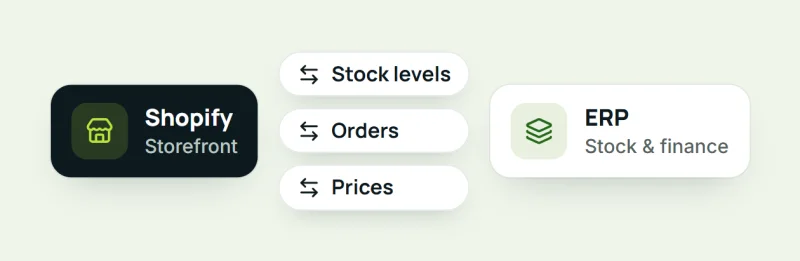
Each manual step adds delay and risk. Overselling a bestseller, shipping to an outdated address or invoicing a trade customer at the wrong price damages trust that took years to build, and the problem grows with every new channel you add. Meanwhile, talented people spend their days copying numbers between screens instead of improving the customer experience.
Custom integrations replace those workarounds with reliable, automated data flows. Shopify stays the hub for selling, while each connected system receives exactly the data it needs, in the right format, at the right moment, and your team gets those hours back for work that actually grows the business.
Who integration work is for
- UK brands outgrowing off-the-shelf connectors that cannot handle their business rules
- Merchants selling across Shopify, Amazon, eBay and wholesale from one stock pool
- Operations teams re-keying data between Shopify and their ERP, 3PL or CRM
- Finance teams that need clean, reconciled sales data every single month
What our Shopify custom development covers
Every integration is scoped around your systems, volumes and business rules. These are the connections we build most often, and your fixed quote lists exactly which ones apply to your project. Nothing is added just to pad the scope.
Shopify ERP integration
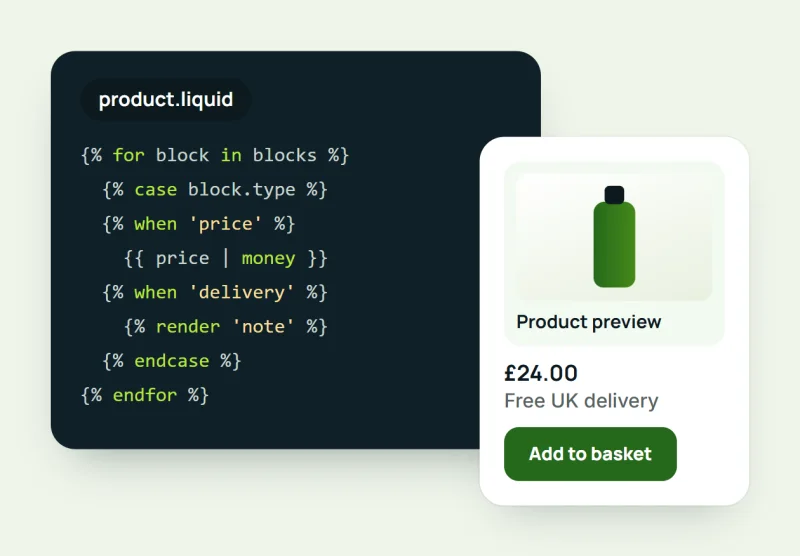
Two-way connections between Shopify and NetSuite, Microsoft Dynamics 365 Business Central, Sage, SAP Business One or Odoo. Products, prices, stock, orders, customers and refunds move automatically, with clear rules deciding which system owns each field. Our dedicated ERP service explains the approach, data mapping and testing in more depth.
Warehouse and 3PL connections
Orders released to your warehouse or third-party logistics partner the moment payment clears, with tracking numbers, partial shipments and returns flowing back into Shopify. Whether you ship from your own unit in Leicester or through a national 3PL, customers get accurate dispatch emails and your service team stops chasing couriers for updates.
Accounting and finance sync
Sales, refunds, fees, gift cards and VAT summarised into Xero, QuickBooks or Sage in a format your accountant recognises. We map tax codes, payment gateways and currencies carefully, so month-end reconciliation takes far less effort and your figures hold up when HMRC, auditors or investors start asking questions.
Product information management
Rich product data from a PIM such as Akeneo or Plytix published into Shopify products, variants and metafields. Merchandisers enrich content once and see it appear across your storefront, marketplaces and wholesale catalogues, without the copy-and-paste errors that creep in when spreadsheets are passed between busy teams.
CRM and customer data
Customer profiles, orders and consent preferences shared with HubSpot, Salesforce or your helpdesk, so sales, service and marketing all see the same history. We respect UK GDPR at every step, sending only the fields each platform genuinely needs and keeping marketing consent synchronised in both directions.
Marketplaces and sales channels
Listings, stock and orders synchronised with Amazon, eBay and other marketplaces from one Shopify catalogue. Where Shopify's own channel apps cover your needs, we configure them properly; where your pricing, bundles or fulfilment rules demand more, we build the missing logic around them and keep everything in step.
Custom APIs and middleware
When no connector exists, we build one. Lightweight middleware listens to Shopify webhooks, transforms the data and calls your supplier's or partner's API, with queues, retries and validation, so a slow third-party system never blocks your checkout or quietly loses an order. Each endpoint is documented, versioned and covered by automated tests.
Data warehouse and reporting
Shopify orders, customers and marketing data piped into BigQuery, Snowflake or your reporting tool, so leadership sees trading performance alongside stock, margin and fulfilment data in one trusted view instead of five conflicting spreadsheets. Clean pipelines also make forecasting and buying decisions far easier.
Monitoring, alerts and support
Every integration ships with logging, health checks and alerts that tell your team, and ours, when something needs attention. Dashboards show sync status at a glance, and an SLA support plan keeps connections current as Shopify releases new API versions each quarter.
Your integration launch roadmap
A typical path from tangled data to dependable automation, with exact timings agreed in your fixed quote before any work begins.
Phase 1
Map and specify
- Systems, data owners and current manual steps mapped end to end, including the awkward exceptions your team quietly handles every week.
- Field-level mapping, sync frequency and error handling agreed in a written specification that you review and approve before any build.
Phase 2
Build and connect
- Connectors developed against sandbox or test environments first, never straight into your live ERP, finance or warehouse systems.
- Historic data cleaned and transformed, so the first full sync starts from accurate records your teams already trust.
Phase 3
Test real scenarios
- Refunds, partial shipments, bundles, discounts and trade orders tested through every connected system, in the order they happen in real life.
- Your team signs off results on staging after one consolidated feedback round, supported by recorded walkthroughs of each data flow.
Phase 4
Go live and monitor
- Cut-over planned for a quiet trading window, with a rollback plan and a manual fallback ready in case anything misbehaves.
- Alerts, monitoring and monthly reporting keep data flowing smoothly as order volumes grow and your systems change over time.
Stages, not fixed durations. Timings are agreed with you once the scope is clear.
How we deliver Shopify custom development
Our ten-stage delivery process, condensed into six milestones you will recognise in every weekly update from your project manager.
Discovery and NDA
We sign an NDA before any data changes hands, then agree goals, system access and scope. You leave knowing whether a connector, a custom build or a mix of both is the smartest route.
Fixed quote
You receive a Starter, Growth or Custom proposal with a fixed price and timeline, so finance can plan the investment once rather than revisiting it after every sprint.
Secure access and planning
Credentials for Shopify and each connected system are shared through a password manager with 2FA, least-privilege scopes and an access log. Your project manager then sets milestones, owners and a RACI.
Sprints and quality checks
Integration specialists build in one-to-two-week sprints with daily internal stand-ups. Every release passes checklists, a 4-eyes code review and lead sign-off before it reaches your team.
Review and cut-over
You test on staging with recorded walkthroughs and give a single feedback round per milestone. Go-live follows a detailed checklist, with rollback steps rehearsed in advance.
Reporting and support
Weekly updates and a monthly KPI report track sync health and volumes. SLA support follows launch, and at offboarding we remove our access and return or delete your data.
Integration tools and technologies
We choose the simplest reliable route for each connection, from Shopify's own APIs to proven integration platforms, and document every choice so your team understands what runs where.
GraphQL Admin API
Shopify's primary API for reading and writing products, orders, customers, inventory and metafields, including bulk operations that move large catalogues efficiently while respecting Shopify's rate limits.
Webhooks and event delivery
Real-time notifications when orders, products or stock change, delivered to your own endpoint, Amazon EventBridge or Google Cloud Pub/Sub for dependable processing at scale.
Shopify Flow
Native automation for tagging, routing and alerts, often handling the simple rules so custom code can concentrate on the complex ones that genuinely need it.
Integration platforms
Where it suits your team, iPaaS tools such as Celigo or Patchworks provide managed connectors, mapping screens and monitoring for common ERP and 3PL routes.
Cloud hosting and queues
Custom middleware runs on established cloud platforms with message queues, retries and encrypted secrets, sized to cope comfortably with peak-season order spikes and flash sales.
Logging and alerting
Structured logs and alerting trace every record from source to destination, so problems are spotted and fixed before customers, couriers or your finance team ever notice.
Where AI adds value to your integrations
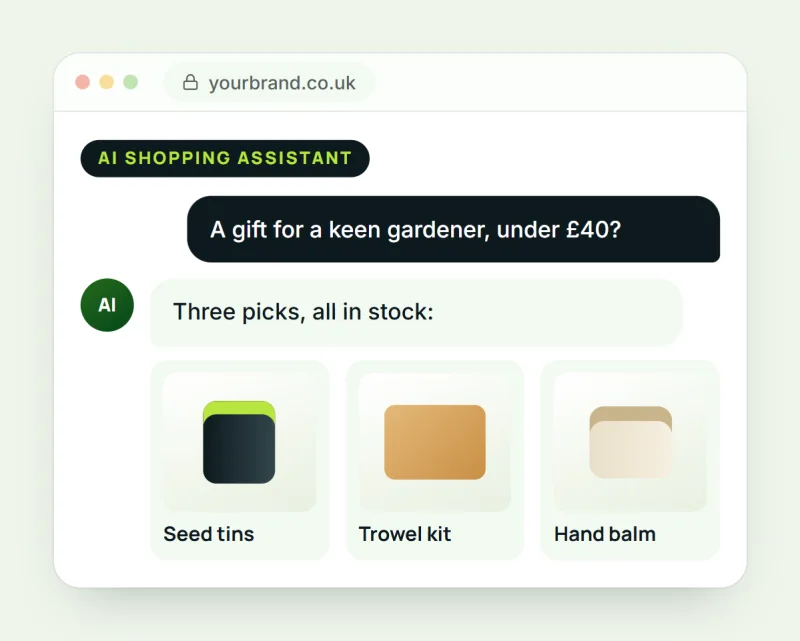
Integrations move data; AI can help make sense of it. Once your systems are connected, clean and consistent records open the door to practical automation that saves your team hours every week, without handing control of critical processes to a black box. AI is only as good as the data it sees, which is why integration comes first.
Useful AI inside connected systems
We design every AI feature with guardrails. Only the data a feature needs leaves your systems, access stays least-privilege, your client data is never used to train AI models and each decision is logged. Anything that changes prices, stock or customer records waits for human sign-off.
For a wider view of where AI fits across trading, content and customer service, explore our hub on AI for Shopify Stores.
- Reading supplier price lists and PDF invoices, then proposing updates for a person to approve
- Suggesting product categories, tags and attributes when new lines arrive from your ERP or PIM
- Summarising sync errors in plain English, so operations staff know what to fix first
- Spotting unusual patterns, such as sudden stock drops or refund spikes, and alerting a human
- Drafting replies to common order-status queries using live data from your 3PL, for agents to check and send
App stack
App stack builder: connector or custom build?
Off-the-shelf connectors are often the fastest win. We start with proven apps and only build custom where your rules, volumes or systems genuinely demand it. That keeps your budget focused on what is truly unique to your operation.
Popular tools by job
Tool names are examples; trademarks belong to their owners.
Inventory and order management
Multichannel sellers need one live stock pool shared across Shopify, marketplaces and wholesale accounts, with purchase orders raised before bestsellers run dry.
- LinnworksMultichannel inventory and order processing
- Cin7 CoreInventory, purchasing and production management
Accounting
Clean, summarised financial data saves hours at month-end, keeps your accountant happy and makes VAT returns far less stressful.
- A2XPayout and fee summaries for your accounting software
Shipping and fulfilment
Labels, tracking and despatch updates generated automatically, without anyone re-keying addresses or order numbers at the packing bench.
- Royal Mail Click & DropUK label printing and tracked services
- ShipStationMulti-carrier shipping with automation rules
Marketplaces
Reach more buyers on the platforms they already use, while Shopify remains the single source of product truth.
- Marketplace ConnectAmazon and eBay listings managed from Shopify admin
Bulk data and automation
Many integration needs start with better data jobs and smarter rules rather than brand-new custom code.
- MatrixifyScheduled imports, exports and data migrations
- Shopify FlowEvent-driven workflows across apps and systems
Pricing for connected Shopify stores
One-off fixed prices, shown ex VAT, from a well-connected store to bespoke integration builds. For a broader view of shopify website cost, visit our pricing page. Every quote is agreed in writing before work starts.
Starter
From £1,995 one-off, ex VAT
Best for: Theme-based store with standard connector apps set up and tested
What it covers:
- Accounting and shipping apps connected
- Data checks completed before launch
- Team walkthrough of every connection
Growth
From £4,995 one-off, ex VAT
Best for: Custom design store with every integration requirement mapped
What it covers:
- Bespoke design for key templates
- Data flows documented for each system
- 4-eyes QA and lead sign-off
Custom
Get a quote
Best for: Bespoke ERP, 3PL or middleware integration – get a quote
What it covers:
- Scoped in discovery under NDA
- Fixed price before development starts
- Monitoring and SLA support available
Fixed prices, agreed before work starts. All prices exclude VAT.
Compare every service on our Shopify pricing page.
See our integration work on a live walkthrough
- NDA signed before any data is shared
- Least-privilege access with 2FA
- UK GDPR and data processing terms
- Your data never trains AI models
Integrations carry a business's most sensitive information: supplier costs, trade price lists, customer records and margin data. That is why every client project we deliver is covered by NDA, and why you will never see client names, system diagrams or results published on this site.
Instead, we run a live screen-share on Zoom or Google Meet. We walk you through comparable integration builds with identifying details removed, showing how data is mapped, how errors are caught and retried, and how monitoring dashboards look day to day. Bring your operations manager, finance lead or IT partner, because their questions usually reveal the most. We can also show how a typical cut-over plan is structured, from final data freeze to the first live order.
The session also shows you how we work: the specifications we write, the way our project managers report progress and the documentation your team receives at handover.
Your own data gets the same protection. We sign an NDA before you share anything, grant least-privilege access with 2FA, follow UK GDPR and delete your data at contract end. Book a Live Walkthrough and see the detail behind the promises before you commit to anything.
Should we use an off-the-shelf connector or a custom integration?
Start with a connector if one handles your systems, volumes and rules well, because it is quicker and cheaper to run. Custom work makes sense when connectors force manual workarounds, cannot express your pricing or fulfilment logic, or struggle at peak. We compare both honestly during discovery before recommending either.
Which systems can you connect to Shopify?
Most systems with a documented API, file transfer or database export can be connected. We regularly work with ERPs, warehouse and 3PL platforms, accounting packages, PIMs, CRMs, helpdesks, marketplaces and reporting tools. If your system is older or bespoke, we assess its interfaces first and tell you plainly what is realistic.
How do you stop overselling across channels?
We agree one source of truth for stock, usually your ERP or inventory platform, then sync levels to Shopify and every other channel quickly and reliably. Safety buffers, reservation rules and alerts for low or mismatched stock add protection, so a popular product does not sell twice during a busy promotion.
What happens if a connected system goes down?
Well-built integrations expect it. Messages are queued and retried automatically, so orders wait safely rather than disappearing, and alerts tell the right people straight away. Once the system recovers, data catches up in order. We also document a simple manual fallback, so your team knows exactly what to do meanwhile.
How much does a custom Shopify integration cost?
It depends on the number of systems, the direction of each data flow, volumes and how much historic data needs cleaning. Bespoke integrations sit in our Custom tier and are quoted at a fixed price after discovery, so you know the full investment before development starts and nothing creeps up later.
Do we need Shopify Plus for custom integrations?
Not usually. Shopify's Admin API and webhooks are available on standard plans, so most integrations work without Plus. Plus brings higher API rate limits, which helps very high-volume stores, along with Plus-only features such as checkout extensions on the main checkout steps. We confirm what your plan supports before quoting.
How do you keep our data secure during integration work?
We sign an NDA before you hand over any data or credentials. We request least-privilege API scopes, store credentials in a password manager with 2FA, keep an access log and encrypt secrets in hosting. Data is handled in line with UK GDPR, never used to train AI models, and returned or deleted when the contract ends.
Who owns the integration code when the project ends?
You do. Code, hosting accounts and documentation are set up in your name or transferred to you at handover, along with diagrams of every data flow. Your in-house team or another partner can take it on, or we can keep it maintained under an SLA support plan with monthly reporting.
Ready to connect Shopify to the rest of your business?
Tell us which systems you run, where data gets stuck and what your team re-keys each week, and we will come back with a clear integration plan, an honest view on connector versus custom, and a fixed-price quote you can plan around with confidence.
Free consultation
Get a fixed quote for custom Shopify Integrations
Share your details and a member of our team will follow up to arrange a brief discussion.
Tell us about your project
What happens next
- You send your store and project details.
- We follow up to arrange a short call.
- On the call, we talk through your goals and explain how we would scope the work.
Talk to us directly
Waverley House, 9 Noel St, London W1F 8GQ
Phone +44 7476 560011 WhatsApp +44 7476 560011 (opens in new tab) Email hello@shopifyagencylondon.co.ukPrefer the full contact page? Visit our Contact / Free Consultation page.