
Shopify ERP integration
Shopify ERP Integration That Keeps Stock and Orders in Sync
One accurate version of stock, prices and orders across Shopify and your ERP.
Our Shopify ERP integration service connects your store to NetSuite, Dynamics 365 Business Central, Sage, SAP Business One or Odoo, so stock is right, orders post automatically and finance finally trusts the numbers again. Fixed prices, NDA-protected delivery and 4-eyes QA keep the whole project calm, predictable and on budget.
Prefer to talk? Call +44 7476 560011 or message us on WhatsApp (opens in new tab)

Why Shopify and your ERP need to talk
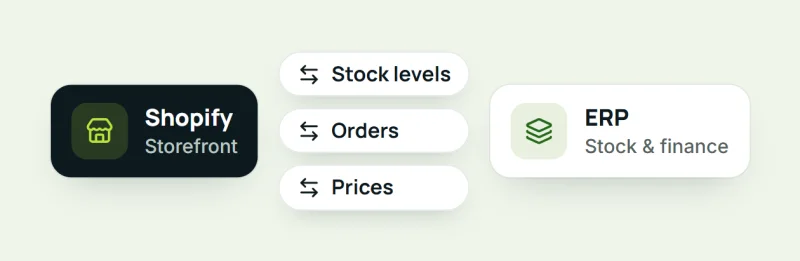
Your ERP holds the truth about stock, costs and customers; Shopify is where you sell. When the two are linked by spreadsheets and manual exports, oversells, late dispatches and month-end headaches follow. Customer service fields questions about orders that the warehouse cannot even see. As part of our shopify custom development work, we replace those gaps with dependable, automated syncs.
A UK homeware brand selling online, through stockists and at seasonal markets, for example, needs every channel drawing on exactly the same numbers, updated without anyone lifting a finger.
Who ERP integration is for
- Brands moving from spreadsheets to their first ERP
- Merchants replacing a fragile legacy connector
- Wholesale and retail sellers sharing one stock pool
- Finance teams tired of reconciling orders by hand
What our Shopify ERP integration includes
Each ERP project is scoped to your system, data and processes. Your fixed quote lists the flows below that apply to your business.

Product and price sync
Products, variants, barcodes and price lists created in the ERP flow into Shopify automatically, including metafields for specifications and care details. Buyers maintain data in one place, and promotional pricing goes live on schedule, without anyone re-entering it in the Shopify admin.
Accurate stock levels
Available stock from every warehouse or location updates Shopify promptly, with safety buffers on fast sellers. That prevents oversells during peak promotions and keeps click and collect availability honest at each of your shops. Multi-location inventory maps to Shopify locations one to one.
Order and fulfilment flow
Paid orders post into the ERP as sales orders with the right customer, tax codes, delivery method and discounts. Dispatch confirmations and tracking numbers flow back to Shopify, triggering the dispatch emails shoppers expect, without your team pressing a button.
Customers and trade accounts
Customer records, trade terms and company accounts stay consistent across both systems. B2B buyers see negotiated prices and payment terms, while credit control keeps working inside the ERP it already knows and trusts.
Refunds, returns and finance
Refunds, exchanges and gift card activity reach the ERP with matching references, so returned stock is booked correctly and finance can reconcile payment provider settlements without line-by-line detective work. Partial refunds and restocking fees are handled too.
Data clean-up before go-live
We audit SKUs, duplicates and missing fields in both systems, agree which platform owns each field and fix the gaps, so automation starts from records everyone trusts, rather than spreading old errors faster.
Error handling and monitoring
Every sync is logged, retried when a system is busy and flagged when human attention is needed. A clear dashboard shows what moved, what failed and why, in plain English. Your team, and ours, is alerted the moment a sync stalls.
Your ERP integration roadmap
The typical journey from first data map to dependable automation. Exact timings are set out in your fixed quote.
Phase 1
Map the data
- Every ERP and Shopify field mapped, with clear ownership rules agreed by both teams.
- Edge cases such as bundles, kits and backorders documented early, not discovered late.
Phase 2
Build the connector
- Syncs developed against your ERP sandbox or test company, never the live ledger.
- Historic SKUs and customer records cleaned before the first full sync.
Phase 3
Test end to end
- Orders, refunds, trade pricing and stock movements tested in realistic sequence.
- Finance and operations sign off results on staging in one feedback round.
Phase 4
Go live and monitor
- Cut-over scheduled for a quiet trading day, with a rollback plan ready.
- Alerts and monthly reporting keep every sync healthy as volumes grow.
Stages, not fixed durations. Timings are agreed with you once the scope is clear.
How we deliver your ERP project
Our ten delivery stages, summarised as five steps your finance and operations teams can plan around.
NDA and discovery
We sign an NDA, review your ERP version, interfaces and processes, and agree goals, access and scope.
Fixed quote and plan
A Starter, Growth or Custom proposal sets price, timeline, milestones, owners and a RACI for both teams.
Secure build sprints
Least-privilege credentials with 2FA, then specialists build in one-to-two-week sprints with daily internal stand-ups.
QA, review and cut-over
Checklists, 4-eyes review and lead sign-off come before your staging tests, then go-live follows a rehearsed checklist.
Reporting and support
Weekly updates, a monthly KPI report and SLA support follow launch; offboarding removes our access and returns or deletes data.
ERP platforms and integration tools
We connect Shopify to the ERPs UK merchants use most, choosing a native connector, an iPaaS or custom code as each case demands.
NetSuite and Business Central
Mid-market ERPs with rich APIs, well suited to multi-location stock, trade pricing and complex fulfilment rules.
Sage, SAP Business One and Odoo
Popular with UK manufacturers and wholesalers; we assess each version's interfaces before committing to an approach.
Shopify GraphQL Admin API
Bulk operations and webhooks move large catalogues and busy order volumes efficiently and reliably.
Celigo and Patchworks
Managed integration platforms with prebuilt flows, ideal when your team prefers configuration over custom code.
Queues and retries
Message queues hold orders safely whenever an ERP is slow or offline, then replay them in sequence.
Where AI helps once your ERP is connected
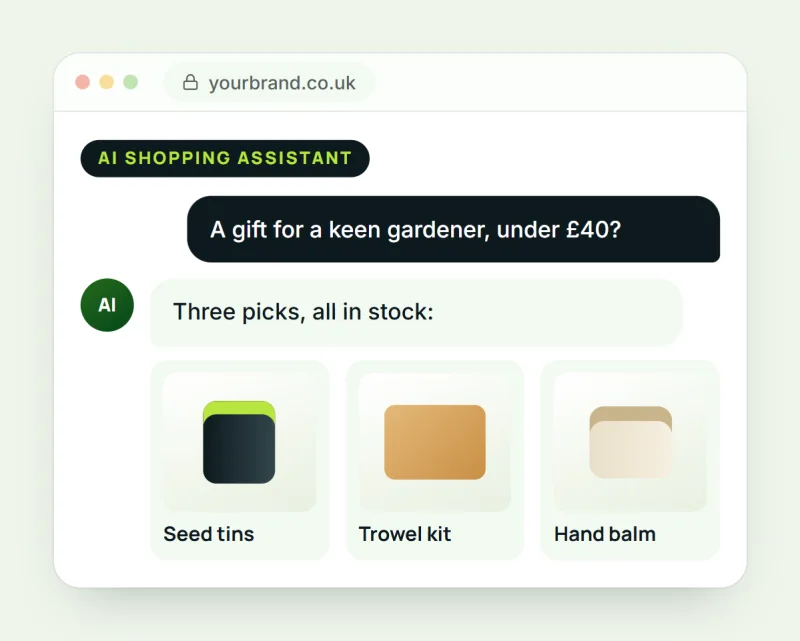
Once Shopify and your ERP share clean data, AI becomes genuinely useful rather than a gimmick, because every prediction draws on real stock, cost and sales history. We build supervised features such as:
- Reorder suggestions based on sell-through across online, retail and wholesale channels
- Duplicate customer and trade account detection before records sync
- Margin alerts when stacked discounts push an order close to cost
- Plain-English summaries of each night's sync activity for the operations lead
A person approves anything that changes prices, stock or customer records, your client data is never used to train AI models and every action is logged for audit, so decisions can always be traced. For more practical ideas, explore our hub on AI for Shopify Stores.
App stack
ERP app stack builder
Some ERP-adjacent needs are met by proven apps, so we build custom only where your processes truly demand it.
Popular tools by job
Tool names are examples; trademarks belong to their owners.
Operations platforms
A lighter route for growing brands not yet ready for a full ERP, or a stepping stone towards one.
- Cin7 CoreInventory, purchasing and assemblies
- BrightpearlRetail operations and order management
Finance and reconciliation
Keeps the ledger tidy between ERP postings and shortens month-end.
- A2XSettlement and fee summaries for your accounts
Returns
Returns data should reach the ERP as cleanly as sales do, with reasons attached.
- Loop ReturnsSelf-serve returns with structured reasons
Workflow automation
Simple rules handled natively before any custom code is even considered.
- Shopify FlowOrder tags, holds and routing alerts
- MatrixifyBulk catalogue imports and exports
ERP integration pricing
Fixed one-off prices, shown ex VAT and agreed before work starts. See how shopify website cost compares across all our services.
Starter
From £1,995 one-off, ex VAT
Best for: Theme-based store ready for a standard ERP connector
What it covers:
- Connector app installed and fully mapped
- Stock and order sync tested
Growth
From £4,995 one-off, ex VAT
Best for: Custom design store with ERP data flows documented
What it covers:
- Field mapping and ownership rules
- 4-eyes QA before launch
Custom
Get a quote
Best for: Bespoke two-way ERP integration – get a quote
What it covers:
- Scoped under NDA in discovery
- Monitoring and SLA support available
Fixed prices, agreed before work starts. All prices exclude VAT.
Compare every service on our Shopify pricing page.
See ERP integration work on a live walkthrough
- NDA signed before any data is shared
- Least-privilege access with 2FA
- UK GDPR and data processing terms
- Your data never trains AI models
ERP data reveals supplier costs, trade terms and margins, so every client integration we deliver is protected by NDA. We never publish client names, data maps, screenshots or results on this site.
Instead, we share our screen on Zoom or Google Meet and walk through comparable Shopify ERP builds with identifying details removed: field mapping, error queues, monitoring dashboards and cut-over plans. Bring your finance director, operations lead or ERP partner along, and test us with your trickiest scenarios.
Your information gets the same care: NDA first, least-privilege access with 2FA, UK GDPR handling and deletion at contract end. Book a Live Walkthrough to see exactly how we would approach your systems and data.
Which ERPs do you integrate?
We work with NetSuite, Microsoft Dynamics 365 Business Central, Sage, SAP Business One, Odoo and most other systems with a documented API. Older on-premise ERPs can often be connected through middleware or scheduled file exchange, which we assess carefully during discovery.
Connector or custom build?
If a connector handles your data, volumes and rules, it is usually the faster, cheaper route and we will say so. Custom builds earn their place when connectors force manual workarounds or cannot express your pricing, bundles or fulfilment logic.
How often does stock sync?
It depends on your ERP. Event-driven syncs update Shopify soon after stock changes, while some older systems only support scheduled batches. We agree the right frequency for each data type and add safety buffers so timing gaps never cause oversells.
Which system owns which data?
We agree that together during mapping. Typically the ERP owns products, costs, stock and trade terms, while Shopify owns storefront content, online orders and marketing consent. Writing these ownership rules down early prevents the two systems overwriting each other later.
Can trade pricing sync?
Yes. Customer-specific price lists, payment terms and credit limits held in your ERP can sync automatically to Shopify's B2B features or a wholesale setup, so logged-in trade buyers see their agreed pricing while retail shoppers see your standard prices.
What if our ERP fails?
Orders keep arriving in Shopify as normal. Our integrations queue them, retry automatically once the ERP is back and post them in the correct sequence. Alerts tell your team what is happening, and a documented fallback covers longer planned maintenance.
Do we need Shopify Plus?
Not for most ERP integrations, because the Admin API and webhooks work on standard plans. Plus offers higher API rate limits, which helps very large catalogues and order volumes. We confirm what your current plan supports before issuing any quote.
How long does integration take?
It depends on your ERP, the number of data flows and how much clean-up is needed. A single stock and order sync moves faster than a full two-way build. Your fixed quote includes a realistic timeline with weekly progress updates.
Ready to connect Shopify and your ERP?
Tell us which ERP you run and where data gets stuck today, and we will send a clear integration plan with a fixed-price quote for your team to review.
Free consultation
Get a fixed quote for shopify ERP Integration
Share your details and a member of our team will follow up to arrange a brief discussion.
Tell us about your project
What happens next
- You send your store and project details.
- We follow up to arrange a short call.
- On the call, we talk through your goals and explain how we would scope the work.
Talk to us directly
Waverley House, 9 Noel St, London W1F 8GQ
Phone +44 7476 560011 WhatsApp +44 7476 560011 (opens in new tab) Email hello@shopifyagencylondon.co.ukPrefer the full contact page? Visit our Contact / Free Consultation page.