
B2B and wholesale
Shopify B2B and Wholesale Stores Built for UK Trade Buyers
Give trade buyers their own prices, terms and fast reorders without running two stores.
Our Shopify B2B service sets up company accounts, customer-specific catalogues, payment terms and quantity rules, so wholesale buyers can log in, see their own prices and reorder in a few clicks while your retail shoppers carry on as normal. A dedicated project manager, a Shopify technical lead and experienced developers handle the configuration, data and integrations at a fixed price, with QA, 4-eyes review and weekly reporting from kick-off to launch day.
Prefer to talk? Call +44 7476 560011 or message us on WhatsApp (opens in new tab)

Who Shopify B2B is built for
Shopify B2B is one of the shopify development services we deliver for brands that sell to consumers and trade accounts at the same time. Plenty of UK wholesalers still take orders by email, phone and spreadsheet, then rekey them into Xero or an ERP. That works until volumes climb. Then mistakes creep in, price lists drift out of date and your sales team spends more time on admin than on winning new stockists.
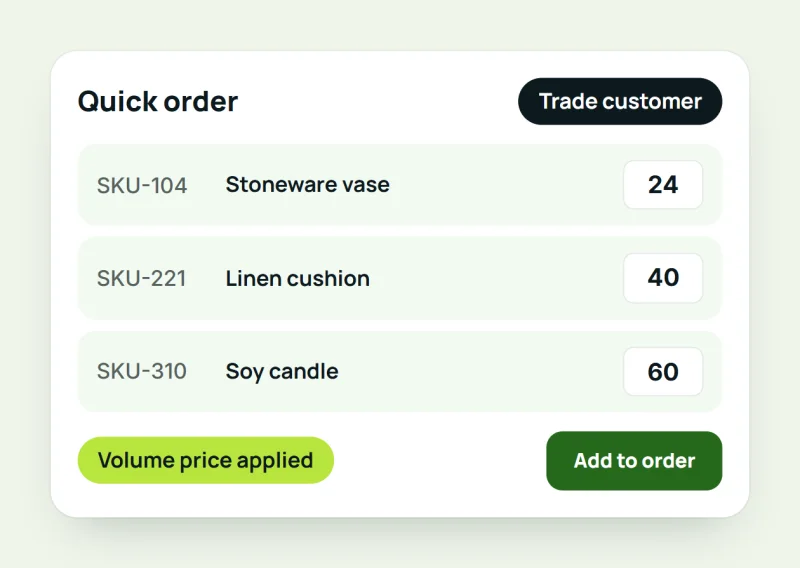
A properly configured trade channel will pay off if you are:
Whether you sell homeware to boutiques in the Cotswolds or ingredients to restaurants in Manchester, the goal is the same: one Shopify admin, accurate pricing for every buyer and an ordering experience your trade customers genuinely prefer to email. Your team gets fewer manual orders to process, and your stockists get the self-service they increasingly expect.
- a DTC brand now supplying independent shops, salons, cafés or garden centres
- a manufacturer or distributor replacing a dated trade portal
- running a separate wholesale site that no longer matches your main store
- managing tiered pricing, minimum order quantities or net payment terms by hand
- heading to a trade show and wanting new stockists to order online straight away
What our Shopify B2B service includes
We configure the native features your plan supports, add apps only where they earn their place and document everything for your team; for background reading, see Shopify B2B and Wholesale Setup.
B2B discovery and plan check
We start by mapping how trade customers order today, which pricing rules apply and which systems hold the master data. Because Shopify's native B2B toolkit is at its most complete on Shopify Plus, we confirm what your plan supports and recommend native features or proven apps accordingly.
Company accounts and buyer access
Each trade customer becomes a company with its own locations, contacts and permissions, so a head-office buyer and a branch manager can both order against the same account. Buyers log in through Shopify customer accounts and only see the prices, products and terms set for them.
Catalogues and customer-specific pricing
We build catalogues that assign fixed prices or percentage adjustments to particular companies or locations, and limit products to the buyers who should see them. Retail prices on your consumer storefront stay untouched, and every price list is checked against your master sheet before launch.
Quantity rules and volume breaks
Minimum order quantities, case-pack increments and maximums are set at variant level, alongside volume pricing that rewards larger orders. Buyers see the rules on the product page before they reach checkout, which means fewer rejected orders and fewer awkward follow-up emails from your sales team.
Payment terms and trade checkout
Trusted accounts can order on terms, such as payment due a set number of days after invoice or on fulfilment, while new stockists pay by card upfront. We also configure tax settings per company location, shipping rules and order review for buyers whose orders need approval first.
Quick order and reorder journeys
Trade buyers rarely browse like consumers. We design quick-order lists, SKU search, saved delivery addresses and fast reorders from previous orders, so a café owner topping up stock on a Monday morning can finish in minutes, whether on a phone in the kitchen or a desktop in the office.
Blended or separate wholesale store
Some brands run consumer and trade sales from one blended store; others prefer a dedicated wholesale storefront with its own navigation and messaging. We weigh up the operational, SEO and reporting trade-offs with you, then build whichever model fits how your teams actually work.
ERP, accounting and inventory links
Orders, stock levels, customer records and invoices need to flow between Shopify and the systems your finance and warehouse teams already use. We connect platforms such as NetSuite, Microsoft Dynamics 365 Business Central, Sage, Xero or Brightpearl through proven connectors or custom middleware.
Data import, testing and training
We import trade customers, contacts and price lists in bulk, then test every pricing scenario, payment term and tax rule with dummy trade accounts. Before launch, your sales and customer service teams get a recorded walkthrough covering account approvals, draft orders and everyday order management.
Your Shopify B2B launch roadmap
Most trade channel projects move through four stages. Real timings depend on the number of price lists, the systems involved and how clean your customer data is, so read these labels as typical stages rather than fixed dates.
Weeks 1–2
Discovery and data review
- NDA signed, trade ordering mapped end to end, and existing price lists, terms and customer records reviewed in detail.
- Plan capabilities confirmed and the native-versus-app decision agreed before any configuration work begins on your store.
Weeks 2–4
Configuration and integration
- Companies, catalogues, quantity rules and payment terms built and checked on a development or staging store first.
- ERP, accounting or inventory connections mapped field by field, then tested end to end with realistic sample orders.
Weeks 4–6
Trade experience and testing
- Quick-order pages, account areas and reorder journeys designed and built to work smoothly on desktop and mobile.
- Every price, rule and tax scenario tested with dummy trade accounts, then passed through 4-eyes review and sign-off.
Launch and beyond
Soft launch and rollout
- A small group of friendly stockists invited first, with their feedback gathered and acted on before the full rollout.
- Weekly updates continue after go-live, with SLA support for new accounts, catalogues and pricing rules as you grow.
Stages, not fixed durations. Timings are agreed with you once the scope is clear.
How we deliver your B2B channel
Every project follows our ten-step delivery system. These are the six stages your team will notice most on a Shopify B2B build, from first call to ongoing support.
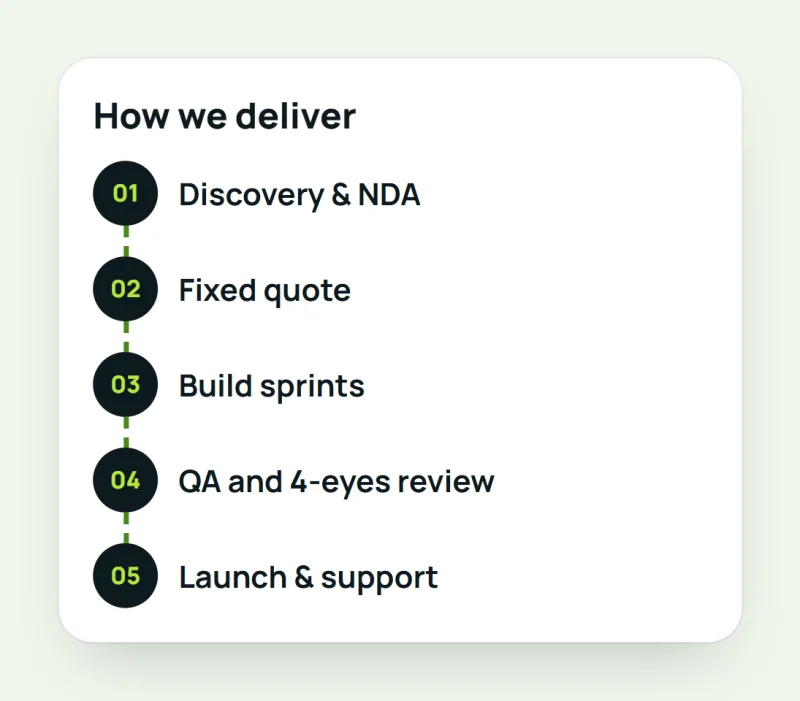
Discovery and NDA
An NDA is signed before you share a single price list. We then agree goals, scope, access and the trade buyer journeys that matter most to your business.
Fixed-price proposal
You receive a Starter, Growth or Custom scope with a fixed price, a clear timeline and the roles involved, so your budget stays predictable from day one.
Secure onboarding and planning
Access is granted on a least-privilege basis through a password manager with 2FA. A roadmap then sets out milestones, owners and a RACI for every workstream.
Build sprints
Specialists work in one- to two-week sprints, with daily internal stand-ups keeping configuration, design and integration work moving in step.
QA and your review
Checklists, 4-eyes review and lead sign-off come first. You then test on staging with preview links, recorded walkthroughs and one consolidated feedback round per milestone.
Launch, reporting and support
Go-live follows a checklist with a rollback plan, then weekly updates, a monthly KPI report and SLA support keep your trade channel healthy as it grows.
Tools and integrations for Shopify B2B
We favour Shopify's native B2B features and connect the business systems you already rely on, so trade orders flow through without anyone rekeying them.
Shopify B2B (native)
Companies, catalogues, payment terms, quantity rules and volume pricing managed inside your Shopify admin, with the fullest feature set on Shopify Plus. We always start here before suggesting extra apps.
NetSuite and Dynamics 365 Business Central
ERPs widely used by growing UK wholesalers, linked to Shopify for orders, stock, customers and invoices through existing connectors or bespoke middleware where nothing off the shelf fits.
Sage and Xero
Popular UK accounting platforms, connected so invoices, payments and VAT records reconcile without manual exports at month end, giving your finance team one reliable source of figures.
Brightpearl and Linnworks
Inventory and order management systems that keep stock accurate across wholesale, retail and marketplace channels at once, so trade buyers never order products you cannot ship.
Shopify Flow
Shopify's automation app for tagging new trade applicants, alerting account managers to large orders and routing approvals to the right person.
Matrixify
Bulk import and export for companies, contacts, products and prices, ideal when moving hundreds of trade customers from spreadsheets or an old portal in one go.
Where AI helps a Shopify B2B channel
Trade buying is repetitive by nature, which makes it a natural fit for well-governed AI. We use it to speed up the parts of a B2B project that usually drain time, and to give your team tools that keep paying back long after launch.
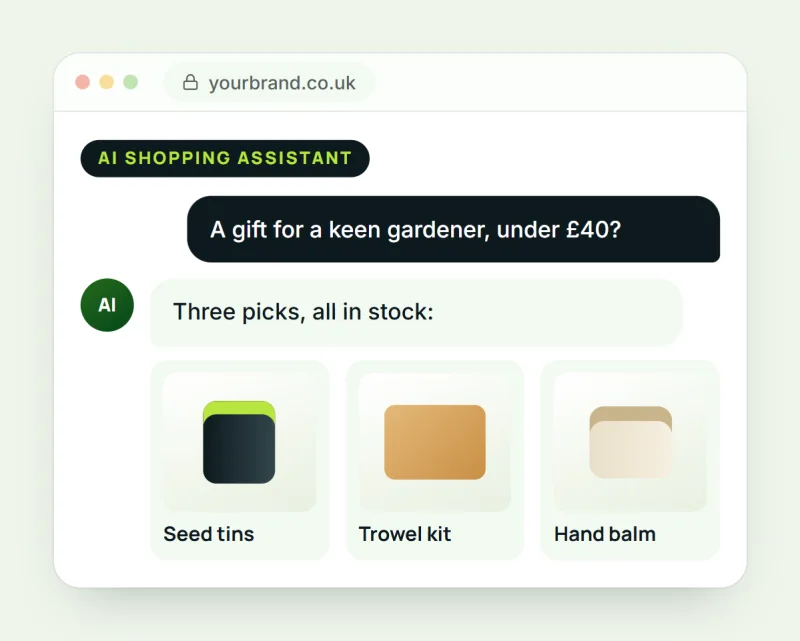
Governance matters as much as speed. Every AI output passes human review, access follows least-privilege rules and your customer data is never used to train AI models. We also flag where AI is not worth the effort yet, so budget goes where it helps. Explore our wider AI for Shopify Stores services to see what else is possible for your trade and retail channels.
- Product data: Shopify Magic can draft technical descriptions, pack sizes and specification copy for wholesale catalogues, which a person then checks for accuracy.
- Admin insight: Sidekick answers questions about orders, customers and stock inside the Shopify admin, helping account managers spot stockists who have stopped reordering.
- Order intake: AI can help turn emailed purchase orders and spreadsheets into draft orders, cutting rekeying while a team member still approves every one.
- Buyer support: an AI agent can handle routine questions about delivery, invoices and terms, passing anything sensitive or unusual to your team.
App stack
Build your B2B app stack
Native B2B covers a great deal, so we only add apps that solve a clear gap. Every extra app adds cost, scripts and another login for your team to manage, which is why we keep the stack small. These established Shopify apps and tools are the ones we most often assess for trade channels.
Popular tools by job
Tool names are examples; trademarks belong to their owners.
Trade pricing and ordering
Useful when you need wholesale features beyond your current plan or richer quick-order tools for high-volume buyers who order by SKU.
- SparkLayerTrade price lists and quick-order forms
- Bold Custom PricingCustomer-specific wholesale pricing
Data and automation
Bulk tools and workflows keep thousands of trade records accurate without hours of manual editing in the admin.
- MatrixifyBulk companies, catalogues and products
- Shopify FlowApproval, tagging and alert workflows
Finance and reconciliation
Clean financial data makes trade terms far easier for your accounts team to manage and chase.
- A2XPayout reconciliation for Xero and QuickBooks
- XeroInvoicing, VAT and credit control
Retention and service
Trade buyers reorder more readily when communication is timely, relevant and easy to act on.
- KlaviyoReorder reminders and trade newsletters
- GorgiasShared helpdesk for trade enquiries
Fixed prices for your trade-ready store
Our fixed, ex-VAT store prices cover setup and design with trade ordering in mind, while Plus-level B2B and ERP work is scoped as Custom after discovery. Learn what shapes shopify website cost for a store like yours.
Starter
From £1,995 one-off, ex VAT
Best for: Theme-based store with gated trade access and wholesale pricing
What it covers:
- Trade application and login
- Bulk import of trade customers
- Recorded team walkthrough
Growth
From £4,995 one-off, ex VAT
Best for: Custom design store with a tailored trade ordering experience
What it covers:
- Bespoke quick-order pages
- Separate retail and trade journeys
- Payment terms and approvals
Custom
Get a quote
Best for: Shopify Plus B2B, ERP integration or multi-store wholesale – get a quote
What it covers:
- Native Plus B2B configuration
- ERP and middleware integration
- Scope agreed after discovery
Fixed prices, agreed before work starts. All prices exclude VAT.
Compare every service on our Shopify pricing page.
See a B2B set-up on a live walkthrough
- NDA signed before any data is shared
- Least-privilege access with 2FA
- UK GDPR and data processing terms
- Your data never trains AI models
Wholesale pricing, trade terms and stockist lists are among the most sensitive data a brand owns, so every B2B project we deliver is covered by a non-disclosure agreement. That is why this page shows no client names, logos or results. You get exactly the same protection: we sign an NDA before you send a price list or grant access to your store.
Rather than a case study, we offer a live screen-share on Zoom or Google Meet. A Shopify technical lead can show you:
- how company accounts, catalogues and payment terms are structured in the admin
- what a trade buyer sees when they log in, search and reorder
- how we map ERP and accounting fields before any integration work starts
- the QA checklist every pricing rule passes before launch
During delivery, access is least-privilege and protected by 2FA, we commit to non-solicit, we follow UK GDPR, your data is never used to train AI models and it is deleted when the contract ends. Read more on our data security and NDA page, or Book a Live Walkthrough at a time that suits your team.
Do I need Shopify Plus to sell B2B on Shopify?
Not always. Shopify Plus offers the most complete native B2B toolkit, including companies, catalogues and payment terms, and Shopify has been extending some B2B features to other plans. Where your plan falls short, established wholesale apps can fill the gaps. We confirm the right route for your plan and budget during discovery.
Can I run wholesale and retail from one Shopify store?
Yes. A blended store lets trade buyers log in and see their own prices, products and terms, while consumers keep shopping at retail prices. Some brands still prefer a separate wholesale storefront for branding or reporting reasons, and we talk through both options honestly before recommending one.
How do trade customers get access to wholesale pricing?
Typically, buyers apply through a trade application form, your team reviews the details and approved accounts are linked to a company with the right catalogue and terms. We can automate parts of the approval with Shopify Flow, such as tagging applicants and notifying the account manager responsible for their region.
Can we offer payment terms to trusted stockists?
Yes. Shopify's native B2B payment terms let you set options such as payment due a fixed number of days after invoice, or on fulfilment, per company location. New or higher-risk accounts can still be asked to pay by card upfront, giving your credit control team flexibility without manual invoicing.
How is VAT handled for UK trade buyers?
We configure tax settings to match your accountant's guidance, including how prices are displayed to trade customers and how VAT numbers are recorded against company locations. We are not tax advisers, so we always confirm the rules for international or exempt buyers with your finance team before launch.
Will a B2B channel affect my SEO?
Trade-only pricing sits behind a login, so search engines see your public catalogue as normal. We keep wholesale landing pages and stockist application pages indexable where they help attract new accounts, and make sure gated content does not create duplicate or thin pages that compete with your retail listings.
Can Shopify B2B connect to our ERP?
Usually, yes. Many ERPs used by UK wholesalers have established Shopify connectors, and where none fit we build custom middleware. Orders, stock, customer accounts and invoices are mapped field by field and tested with sample data. For larger programmes, our Shopify Plus Build Growth tier (Plus + integrations + B2B) starts from £19,995.
What does a Shopify B2B project cost?
It depends on your plan, catalogue and integrations. Store builds start from £1,995 for a theme-based store and £4,995 for a custom design store, both ex VAT. Native Plus B2B and ERP work is scoped as Custom after discovery, and every quote is fixed before any work begins.
Ready to open your trade channel on Shopify?
Share how your wholesale customers order today, the systems involved and your growth plans, and we will reply with a fixed-price B2B scope, a realistic timeline, the specialists assigned to your project and the first practical steps to get your stockists ordering online.
Free consultation
Get a fixed quote for shopify B2B / Wholesale
Share your details and a member of our team will follow up to arrange a brief discussion.
Tell us about your project
What happens next
- You send your store and project details.
- We follow up to arrange a short call.
- On the call, we talk through your goals and explain how we would scope the work.
Talk to us directly
Waverley House, 9 Noel St, London W1F 8GQ
Phone +44 7476 560011 WhatsApp +44 7476 560011 (opens in new tab) Email hello@shopifyagencylondon.co.ukPrefer the full contact page? Visit our Contact / Free Consultation page.