
Shopify headless commerce
Shopify Headless Storefronts Built for Speed and Creative Freedom
Fully custom, lightning-quick storefronts powered by Shopify's catalogue, checkout and order engine.
Shopify headless development separates your storefront from Shopify's back end, giving your brand complete design freedom, rich editorial content and app-like speed while Shopify keeps handling products, payments and checkout reliably behind the scenes. Our London team plans, designs, builds and supports Hydrogen and custom front ends at a fixed price, with a dedicated project manager, specialist leads and 4-eyes QA, and we will tell you honestly if a well-built theme would serve your growth plans better.
Prefer to talk? Call +44 7476 560011 or message us on WhatsApp (opens in new tab)

When your theme starts holding the brand back
Online Store 2.0 themes are excellent, and most of our shopify development services begin there. Yet some ambitious UK brands reach a ceiling. Creative teams want editorial storytelling that sections cannot express, content is scattered across several systems, and every new app adds another script that drags down mobile pages. Developers end up spending more time working around the theme than building features that sell.
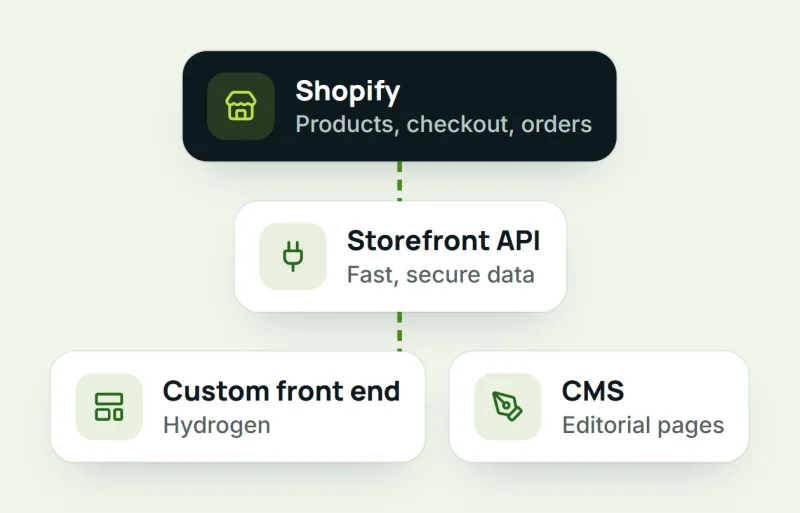
Shopify headless removes that ceiling. Your storefront becomes its own application, built with Hydrogen or another modern framework, pulling products, prices and stock from the Storefront API and handing shoppers to Shopify's secure checkout to pay. Design, content and performance are no longer limited by what a theme allows, while trading, stock and fulfilment stay exactly where your team knows them, inside Shopify admin.
Who a headless build suits
Headless also means more code to look after, so we only recommend it when the growth upside clearly outweighs that responsibility, and we say so plainly when it does not.
- Fashion and lifestyle brands running magazine-style campaigns and lookbooks
- Merchants publishing one catalogue to web, mobile app and in-store screens
- Teams already using a headless CMS or planning a native app
- Brands with in-house developers ready to own and evolve a custom codebase
What our Shopify headless builds include
Every headless project is shaped around your brand, content model and team. These are the components we deliver most often, and your fixed quote states exactly which ones apply to you. Nothing is bundled in just for the sake of it.

Architecture and discovery
Before any code, we map your content, catalogue, markets and integrations, then choose between Hydrogen and other frameworks such as Next.js. You receive a written architecture plan covering hosting, caching, SEO, analytics and ownership, so everyone understands the commitment, the running costs and the trade-offs before a single sprint begins.
Hydrogen storefront build
Shopify's React-based framework gives us ready-made commerce components, server-side rendering and built-in caching. We build your storefront to load quickly on real UK mobile connections, with clean routes, accessible components and well-documented code that your future developers can follow without needing a guided tour from us.
Oxygen or alternative hosting
Hydrogen storefronts can deploy to Oxygen, Shopify's own global hosting, with preview environments for every change your team wants to review. Where a different framework fits better, we deploy to platforms such as Vercel and set up monitoring, alerts and clearly separated staging and production environments from day one.
Headless CMS integration
Marketers need to publish without waiting for a developer. We connect Sanity, Contentful, Storyblok or Shopify metaobjects, model your content around real campaigns and give editors live previews, so a Shoreditch pop-up announcement or a seasonal drop can go live the moment your team is ready.
Cart, checkout and accounts
Carts are built on the Storefront API and hand off to Shopify's hosted checkout, keeping Shop Pay, accelerated wallets and your checkout extensions intact. Customer accounts connect through Shopify's Customer Account API, so order history, saved addresses and reorders feel seamless and familiar rather than bolted on.
Search, filtering and merchandising
Product discovery decides conversion. We wire up Shopify's native search and filtering or a specialist platform such as Algolia, then build fast collection pages with filters, sorting and merchandising rules that your trading team can adjust daily, for sales, launches and stock changes, without ever opening a code editor.
Headless SEO and analytics
Server-side rendering, structured data, XML sitemaps, canonical tags and redirects are handled from the first sprint, so hard-won rankings stay protected. Analytics and consent handling are rebuilt for UK GDPR and PECR, with Shopify analytics, GA4 and ad platforms tested against real orders before launch.
International storefronts
Shopify Markets data flows through the Storefront API, so one codebase can serve the right currency, language and pricing to shoppers in the UK, Ireland, Europe or the US, with localised routes that search engines understand and duties messaging that avoids nasty surprises at delivery.
Handover and ongoing support
Launch day is a starting line, not a finish. We hand over architecture notes, component documentation and recorded CMS training, and transfer the repository and hosting accounts into your name. An SLA support plan can then cover framework upgrades, security patches and a steady backlog of conversion experiments.
Your headless launch roadmap
Headless projects reward careful sequencing. This is the typical journey from first workshop to a storefront that keeps improving, with exact timings set out in your quote.
Phase 1
Discover and architect
- NDA signed, goals agreed and the honest headless-or-theme question answered with evidence from your analytics, content plans and trading roadmap.
- Framework, hosting, CMS and integration choices captured in a written architecture plan that your team reviews, challenges and signs off.
Phase 2
Design and content model
- Mobile-first designs for key templates, built as reusable components rather than one-off pages that become hard to maintain over time.
- Content types modelled in the CMS so editors can assemble campaigns, landing pages and lookbooks on their own, without developer help.
Phase 3
Build, integrate and test
- Storefront, CMS, search, reviews and analytics developed in short sprints, with preview links for every feature as it lands for review.
- Performance, accessibility, SEO and checkout hand-off tested on real phones and browsers before lead developer sign-off.
Phase 4
Launch and optimise
- Redirects, sitemaps and tracking verified on go-live day, with a tested rollback route to the previous storefront if anything misbehaves.
- Monthly reporting on speed, conversion and search visibility feeds a prioritised backlog of improvements for the next quarter.
Stages, not fixed durations. Timings are agreed with you once the scope is clear.
How we deliver Shopify headless projects
Our ten-stage delivery process, grouped into six milestones you will recognise in every weekly update from your project manager.
Discovery and NDA
Our NDA comes first, before you share a single file. We then agree goals, access and scope, and test whether headless genuinely beats a high-performance theme for your brand.
Fixed quote
You receive a Starter, Growth or Custom proposal with a fixed price and timeline, so the headless budget is settled before design starts rather than drifting sprint by sprint.
Secure onboarding and planning
Least-privilege access is granted through a password manager with 2FA and an access log. Your project manager then sets the roadmap, milestones, owners and RACI.
Build sprints and QA
Front-end, back-end and CMS specialists deliver in one-to-two-week sprints with daily stand-ups. Nothing reaches you until it has passed our checklists, a 4-eyes review and lead sign-off.
Review and launch
You test on preview links with recorded walkthroughs and give one feedback round per milestone. Go-live follows a checklist, with a rollback plan ready.
Reporting and support
Weekly updates and a monthly KPI report continue after launch. SLA support keeps dependencies current, and offboarding removes our access and returns or deletes your data.
The headless toolkit we build with
We favour Shopify's supported headless stack and widely adopted open-source tools, so your storefront never depends on one agency, one developer or one proprietary platform.
Storefront API
Shopify's GraphQL API for custom storefronts, exposing products, collections, carts, Markets pricing and metaobjects to any front end you choose, from websites and native apps to in-store screens.
Hydrogen
Shopify's official headless framework, with commerce components, caching utilities and analytics helpers that shorten build time and keep your storefront closely aligned with Shopify's own product roadmap.
Oxygen
Shopify's hosting for Hydrogen storefronts, deployed close to shoppers worldwide, with preview deployments so stakeholders can review every change before it reaches customers.
Next.js and Vercel
A proven alternative when your team already works in Next.js or your storefront shares code, components or content with other web properties beyond the shop itself.
Headless sales channel
Shopify's Headless channel manages Storefront API access tokens for each storefront, keeping permissions tidy and making separate staging and live storefronts simple to control and audit.
Git and automated deployment
Every change is version-controlled, peer-reviewed and deployed through automated pipelines, so releases are repeatable, traceable and easy to roll back if a problem ever slips through.
AI and headless commerce: built for what comes next
A headless architecture is a natural home for AI because every part of the storefront talks through APIs. That makes it far easier to plug in AI-powered search, personalised recommendations or a shopping assistant without fighting theme limitations or stacking yet another script onto the page. Recommendation engines, visual search and conversational shopping all slot in as separate services, so you can trial one idea without rebuilding the storefront.
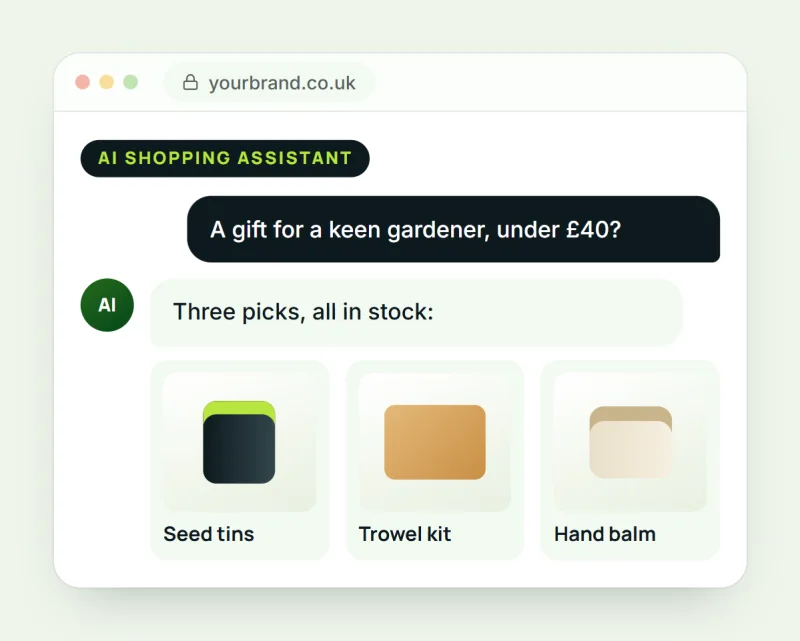
It also helps you get found. Server-rendered pages and clean, structured product data make your range easier for search engines and AI shopping assistants to understand, which matters more every month as customers start their buying journeys in chat tools rather than search boxes.
How we use AI responsibly in headless builds
To understand where AI can drive growth across your store, from Shopify Magic to custom agents, visit our hub on AI for Shopify Stores.
- AI-assisted product and campaign copy drafted inside your CMS, always approved by a person before it is published
- Only the data a feature genuinely needs, shared under least-privilege access
- Your client data never used to train AI models
- Clear logs showing what each model receives and returns
- Every AI component built to be swapped or switched off without a rebuild
App stack
Headless app stack builder
Not every Shopify app works on a headless storefront, because many rely on theme app blocks. We choose tools with solid APIs or headless support and build cleanly around them. Where no good option exists, a small custom integration usually fills the gap.
Popular tools by job
Tool names are examples; trademarks belong to their owners.
Content management
Editors publish campaigns, lookbooks and landing pages on their own schedule, without waiting for a developer or a fresh deployment.
- SanityStructured content, synced with Shopify via Sanity Connect
- ContentfulContent modelling and localisation for larger teams
Search and discovery
Fast, relevant results keep shoppers moving from browse to basket on every device, especially on busy sale days.
- AlgoliaSearch and merchandising delivered through its API
- Shopify Search & DiscoveryNative filters, synonyms and product recommendations
Reviews and UGC
Social proof still needs to appear on product and collection pages, even without a theme to host widgets.
- OkendoReviews with support for headless storefronts
- YotpoReviews and loyalty, accessible through its APIs
Email and SMS
Browse, cart and post-purchase flows depend on clean, reliable events sent from the custom storefront.
- KlaviyoFlows triggered by storefront and order events
Subscriptions
Replenishment brands keep recurring revenue flowing smoothly through a custom front end and account area.
- RechargeSubscriptions and customer portal with headless options
Pricing: from fast theme to full headless
Prices are fixed, one-off and shown ex VAT. Many brands start with a fast theme and move headless once growth demands it; see the full picture of shopify website cost on our pricing page.
Starter
From £1,995 one-off, ex VAT
Best for: Theme-based store, for brands that do not yet need headless
What it covers:
- Fast, conversion-focused theme setup
- Core apps installed and tested
- Launch checklist and team handover
Growth
From £4,995 one-off, ex VAT
Best for: Custom design store with a headless readiness review
What it covers:
- Bespoke design for key templates
- Content model ready for a CMS
- 4-eyes QA and lead sign-off
Custom
Get a quote
Best for: Full Shopify headless build with Hydrogen and CMS – get a quote
What it covers:
- Architecture scoped under NDA
- Fixed price before build starts
- SLA support after launch
Fixed prices, agreed before work starts. All prices exclude VAT.
Compare every service on our Shopify pricing page.
Explore a headless build on a live walkthrough
- NDA signed before any data is shared
- Least-privilege access with 2FA
- UK GDPR and data processing terms
- Your data never trains AI models
Headless projects usually sit at the heart of a brand's growth plans: new markets, new product lines and campaigns that competitors would love to see early. That is why all our client work is delivered under NDA, and why this site never names clients, shows their storefronts or publishes their results.
Instead, we offer a live screen-share on Zoom or Google Meet. We will walk you through comparable headless architecture with identifying details removed, show how content flows from CMS to storefront, demonstrate preview environments and explain the caching and SEO decisions behind a fast build. Bring your head of ecommerce, creative lead or CTO, because the best sessions are full of difficult questions.
It is also a practical test of fit. You will see how our project managers report, how our developers document code and how handover works when your own team takes the keys.
Before you share anything about your store, we sign an NDA. Access is least-privilege with 2FA, handled under UK GDPR, never used to train AI models and deleted at contract end. Book a Live Walkthrough and see what headless could look like for your brand.
What does Shopify headless actually mean?
It means your storefront, the part shoppers see, is a separate application from Shopify's back end. Shopify still manages products, inventory, orders and checkout, while a framework such as Hydrogen renders the pages. The two talk through Shopify's Storefront API, which gives designers and developers far more freedom than a theme.
Is a headless storefront faster than a Shopify theme?
It can be, but speed is never automatic. A well-built headless storefront with server-side rendering and sensible caching can feel extremely quick, while a poorly built one can be slower than a lean theme. We set performance budgets during discovery and test real devices throughout, so speed is engineered rather than assumed.
Do we need Shopify Plus to go headless?
Not necessarily. The Storefront API and Hydrogen are not reserved for Plus merchants, so headless is open to many growing brands. Plus does add capabilities that larger headless projects often want, such as checkout UI extensions on the main checkout steps. We confirm exactly what your current plan supports during discovery.
Will our existing Shopify apps still work?
Apps that run in Shopify admin or the back office usually carry on as normal. Apps that inject features into a theme, such as review widgets or upsell blocks, need an API-based alternative or a custom integration. We audit your app stack early, so there are no surprises halfway through the build.
What happens to our SEO when we go headless?
Handled properly, rankings are protected and often easier to improve. We render pages on the server, generate sitemaps and structured data, preserve URLs where possible and map redirects where they change. Search Console is monitored closely after launch, and any crawl or indexing issue is fixed quickly by the team that built it.
Is Hydrogen the right framework for us?
Hydrogen is our default for Shopify-first brands because it is built and maintained by Shopify, but it is not the only option. Our guide, Shopify Headless: Hydrogen Pros and Cons, compares it with other approaches, and we give you a clear recommendation during discovery.
Can our marketing team still edit pages without developers?
Yes, and that is a key reason to pair headless with a CMS. Editors build pages from approved components, preview them live and publish on schedule. We train your team during handover and document every content type, so launching a campaign never means joining a developer's queue.
Who maintains a headless storefront after launch?
You own the code, so your in-house developers can take it on, or we can maintain it under an SLA support plan. Ongoing work covers framework updates, Shopify API version changes, security patches and new features, with weekly updates and a monthly report so you always know what changed and why.
Ready to find out if headless is right for your brand?
Share your growth plans, your current store and the limits your team keeps hitting, and we will come back with an honest headless-or-theme recommendation, a clear architecture outline, the likely risks and a fixed-price quote you can take straight to your board.
Free consultation
Get a fixed quote for shopify Headless Development
Share your details and a member of our team will follow up to arrange a brief discussion.
Tell us about your project
What happens next
- You send your store and project details.
- We follow up to arrange a short call.
- On the call, we talk through your goals and explain how we would scope the work.
Talk to us directly
Waverley House, 9 Noel St, London W1F 8GQ
Phone +44 7476 560011 WhatsApp +44 7476 560011 (opens in new tab) Email hello@shopifyagencylondon.co.ukPrefer the full contact page? Visit our Contact / Free Consultation page.