
Shopify store development
Shopify Web Development Built for Growing UK Brands
Clean code, dependable integrations and a store your team can grow without workarounds.
Our Shopify web development team builds and extends stores for UK brands that have outgrown quick fixes, from custom sections and product logic to ERP, warehouse and accounting integrations that keep orders, stock and finance data flowing without anyone re-keying a thing. Every release is version-controlled, peer-reviewed and tested on a staging theme before it goes live, with a fixed price agreed upfront and a dedicated project manager keeping your development roadmap firmly on schedule from kick-off to release.
Prefer to talk? Call +44 7476 560011 or message us on WhatsApp (opens in new tab)

When your store starts holding the business back
Most Shopify stores begin simply: a theme, a handful of apps and a spreadsheet or two. Then growth arrives and starts exposing the cracks one by one. Our shopify development services are built for the moment those cracks start costing you money, whether that is stock drifting out of sync with your warehouse, staff re-keying orders into accounting software, pages slowed by forgotten app code or theme edits that nobody dares to touch.
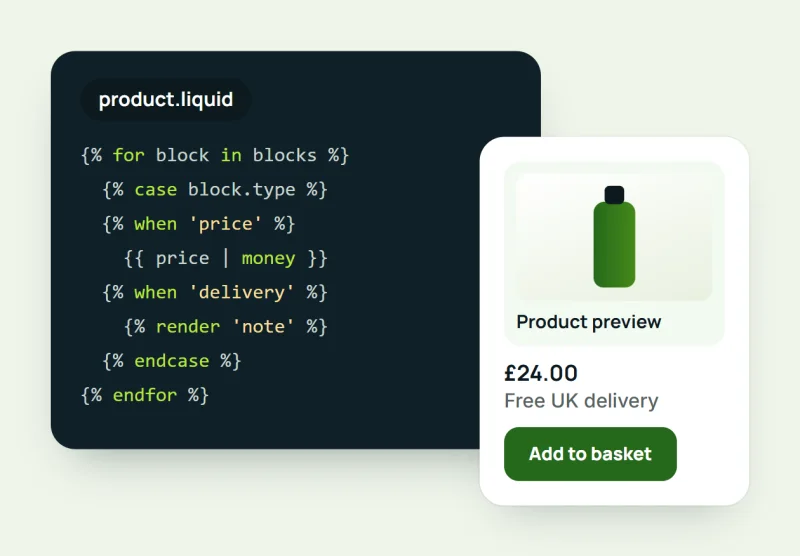
Workarounds feel cheap until peak season arrives. When a Black Friday campaign or a big product drop lands, fragile customisations and manual processes are usually the first things to break. Proper development replaces guesswork with documented, tested code and integrations that run quietly in the background while your team gets on with buying, marketing and selling.
Who this service is built for
- Growing DTC brands adding features their current theme cannot handle.
- Businesses connecting Shopify to an ERP, 3PL, PIM or accounting system.
- Teams inheriting a store from a freelancer who is no longer available.
- Retailers expanding into new markets, sales channels or wholesale.
- In-house ecommerce and marketing teams who need a reliable development partner on call for new features, fixes and campaign builds.
What our Shopify web development service covers
Every build is scoped around your trading model, your systems and the people who will run the store day to day. All code is reviewed by a second developer and signed off by a technical lead before you ever see it on a staging link.
Technical discovery and solution design
We map your products, order flow, systems and pain points, then recommend the simplest architecture that will genuinely work for your team, deciding what belongs in the theme, in apps, in Shopify Flow or in a custom integration.
Theme build and customisation
We build on Online Store 2.0 using Liquid, JSON templates and reusable sections, either extending a quality theme or developing a custom one from scratch, always keeping your content editable in the theme editor by non-technical staff.
Structured content with metafields
Size charts, ingredients, care guides, specifications and store locations become structured metafields and metaobjects instead of hard-coded text, so your team updates them once and they display correctly on every relevant product, page and template.
Custom product logic
Bundles, gift messages, personalisation fields, pre-orders and tiered discounts are built with native features or Shopify Functions wherever possible, keeping checkout reliable, pages light and monthly app subscriptions under control.
System integrations
We connect Shopify to ERP, warehouse, PIM, CRM and accounting platforms through the Admin API and webhooks, with error alerts, logging and retry logic so failed syncs are caught and resolved quickly, not weeks later.
Custom apps for your store
When nothing in the Shopify App Store does the job properly, we build a lightweight custom app just for your store, securely hosted, fully documented and handed over so you are never locked in to us or any single developer.
Performance engineering
We audit Core Web Vitals, remove unused app code, optimise images and fonts and tidy heavy scripts, so pages load quickly on mobile connections, shoppers stay engaged and search engines see a healthy, well-built site.
Analytics and tracking
GA4, Meta and Google Ads tracking are set up through Shopify's customer events and the official sales channel apps, with cookie consent respected, so your reports and ad platforms reflect what customers really do on your store.
Automation with Shopify Flow
Repetitive jobs such as tagging high-value customers, flagging risky orders or alerting the team to low stock run automatically, freeing your staff for the customer and product work that genuinely needs a person.
Version control, QA and releases
Code lives in GitHub, changes are tested on preview themes across devices and browsers, and releases follow a checklist with a rollback plan, so updates never feel like a gamble on a busy trading day or the night before a big launch.
Data migration and catalogue imports
Moving from another platform or tidying a messy catalogue? We import products, customers and order history with Matrixify, mapping every field carefully, protecting SEO with redirects and checking totals against your source data.
Your Shopify development roadmap
Most development projects, from a single feature to a full rebuild, follow four broad stages. Exact timings depend on scope, integrations and how quickly decisions are made, so they are confirmed in your fixed quote rather than promised here.
Stage 1
Discovery and architecture
- NDA signed, your existing store and systems audited, and requirements captured as clear user stories with agreed acceptance criteria.
- Technical approach, integration map, data ownership and release plan agreed in writing before any code is written.
Stage 2
Build sprints
- Features developed in one- to two-week sprints on a separate development theme or store, safely away from live customers.
- A short demo at the end of each sprint, so you can see real progress, ask questions and steer priorities early.
Stage 3
Integration and testing
- Data syncs tested with realistic scenarios, including refunds, part shipments, cancellations and out-of-stock edge cases.
- Peer code review, cross-device testing and your own user acceptance testing on a staging preview before sign-off.
Stage 4
Release and optimise
- Go-live checklist followed, release closely monitored and a rollback plan ready if anything misbehaves.
- Handover documentation and training delivered, then weekly reporting and SLA support as your development roadmap continues.
Stages, not fixed durations. Timings are agreed with you once the scope is clear.
How we deliver development work
Behind every build sits our ten-step delivery process. These are the six stages you will see most clearly, whether your project lasts a few weeks or runs as an ongoing roadmap.
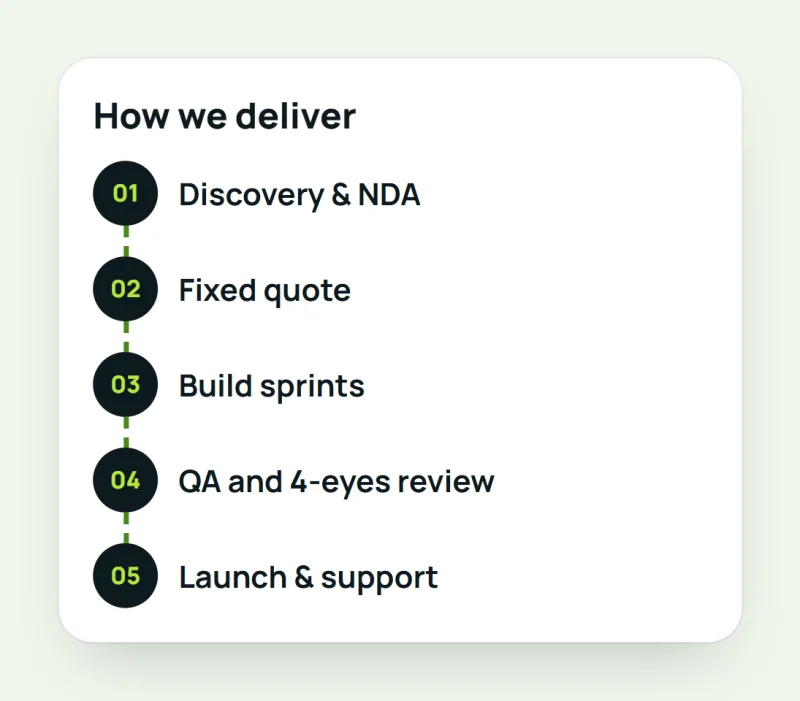
Discovery and NDA
Confidentiality is agreed first. Then we review your store, systems and commercial goals, and agree scope, access and success measures in writing.
Fixed proposal
Your Starter, Growth or Custom proposal sets out deliverables, price and an indicative timeline, so budget conversations happen once, at the start.
Secure access and planning
Access is granted through a password manager with two-factor authentication and logged, while your project manager builds a roadmap with clear owners and milestones.
Sprints and stand-ups
Developers work in focused sprints with daily internal stand-ups, so blockers surface early, questions reach you quickly and your feature list keeps moving week after week.
Quality assurance
Automated checks, a four-eyes code review and lead sign-off all come before you receive a staging link with a recorded walkthrough.
Release and support
We deploy against a go-live checklist, report weekly and monthly on progress and KPIs, then provide SLA support for whatever your next stage of growth demands.
Platforms, tools and integrations we work with
Shopify rarely runs alone. We connect your store to the systems behind it and use proven developer tooling, so data flows reliably and every change can be traced back to a person and a reason.
Shopify CLI and GitHub
Themes and apps are developed locally with Shopify CLI and stored in GitHub, giving every change a full history, a named reviewer and an easy way back if needed.
Shopify APIs and webhooks
We use Shopify's GraphQL Admin API, the Storefront API and event webhooks to move orders, stock and customer data between your systems promptly.
ERP and inventory platforms
Integrations with NetSuite, Microsoft Dynamics 365 Business Central, Brightpearl and Linnworks keep stock, orders and fulfilment aligned across every channel you sell through.
Xero, QuickBooks and Sage
Sales, fees, refunds and VAT reach your accounting software through recognised connectors, ready for month-end and quarterly VAT returns.
Middleware platforms
For complex flows, tools such as Celigo or Patchworks handle mapping, retries and monitoring between Shopify and your back-office systems.
Matrixify
Bulk imports and exports of products, customers, redirects and metafields, ideal for catalogue clean-ups, scheduled updates and platform moves.
Where AI fits into a modern store build
AI is changing how stores are built and run, but it delivers most when experienced developers check every result. Here is where it adds genuine value to a development project, and where we keep people firmly in control.
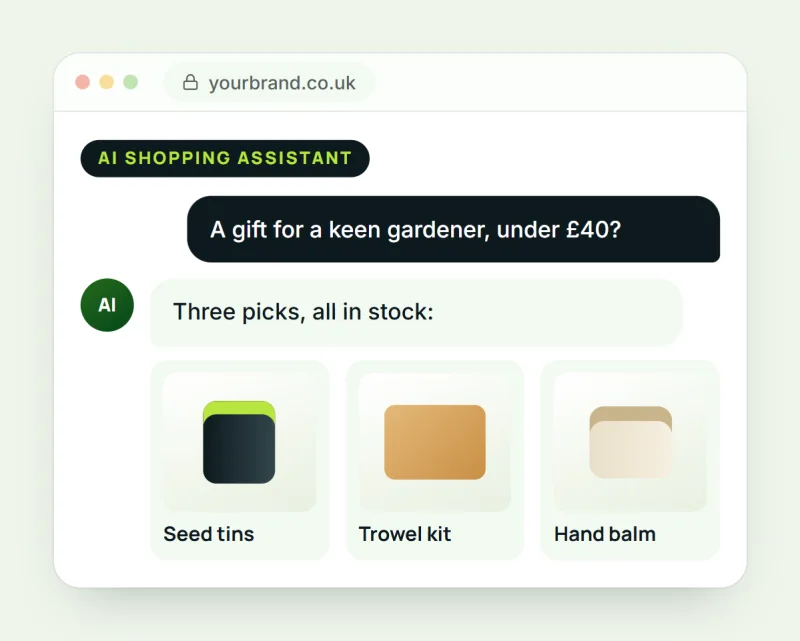
Your data is never used to train AI models, and every AI feature is configured with clear permissions. Explore our full range of AI for Shopify Stores services to see what else is possible for your business.
- Faster, reviewed coding: where AI coding assistants speed up routine work such as boilerplate or test scenarios, a developer still reviews, runs and takes responsibility for every change before it reaches your store.
- Structured data for AI shopping: metafields, metaobjects and clean product attributes make your catalogue easier for AI shopping assistants and AI-powered search to understand and recommend.
- AI agents with guardrails: assistants connected to your store data through Shopify's APIs can answer order questions or summarise trends, within limits we design and test.
- Admin tools for your team: Shopify Magic and Sidekick help staff draft content, find settings and pull quick sales insights once the build is handed over, and we show them how during training.
App stack
Choose an app stack that scales with you
We treat apps the way we treat code: each one must justify its cost, its impact on speed and the data it can access. Here is a typical operational stack for a growing UK brand, which we tailor to your range, team size and systems.
Popular tools by job
Tool names are examples; trademarks belong to their owners.
Automation and data
Cut manual admin, automate routine checks and keep a large, changing catalogue tidy as the business grows and more people work in the admin.
- Shopify FlowNo-code workflows inside the admin
- MatrixifyBulk imports, exports and scheduled jobs
Subscriptions
Turn repeat purchases into predictable revenue with flexible plans that customers can manage themselves without emailing your team.
- RechargeSubscriptions with a self-service portal
- Shopify SubscriptionsFree app for simpler plans
Returns and exchanges
Make returns painless for customers while nudging them towards exchanges and store credit that protect your revenue.
- Loop ReturnsExchange-first returns portal
- Shopify self-serve returnsNative return requests for simpler needs
Customer service
Give your agents order details beside every conversation, so delivery, refund and sizing questions are resolved in a single reply.
- GorgiasEcommerce helpdesk with order actions
- Shopify InboxFree chat for smaller teams
Shopify store development pricing
Development projects are quoted as fixed one-off fees, ex VAT, and agreed before work begins. For context on shopify website cost across builds, migrations and ongoing support, see our pricing page, where every package is listed side by side.
Starter
From £1,995 one-off, ex VAT
Best for: Theme-based store, built and extended to fit your operation.
What it covers:
- Quality theme with custom sections
- Core apps and tracking connected
- Staging review and launch checklist
Growth
From £4,995 one-off, ex VAT
Best for: Custom design store with bespoke features built in.
What it covers:
- Custom theme coded on Online Store 2.0
- Structured content with metafields
- Weekly progress reporting to launch
Custom
Get a quote
Best for: Complex integrations, custom apps or several stores. Get a quote.
What it covers:
- Architecture planned in discovery
- Fixed quote before development
- Dedicated PM and technical lead
Fixed prices, agreed before work starts. All prices exclude VAT.
Compare every service on our Shopify pricing page.
Our code is confidential, but our standards are on show
- NDA signed before any data is shared
- Least-privilege access with 2FA
- UK GDPR and data processing terms
- Your data never trains AI models
Development work gives us deep access: order data, supplier pricing, integration credentials and plans that competitors would love to see. Every single engagement is therefore covered by a non-disclosure agreement, which is why we never publish client names, store links or results on this site.
We would rather prove our standards live. In a screen-share on Zoom or Google Meet, a senior developer can walk you through real repositories, pull-request reviews, integration diagrams, QA checklists and release notes, with anything confidential or identifying removed beforehand. Ask how we handle a failed stock sync, a peak-day release or a theme that nobody documented, and you will see exactly how we work in practice rather than hearing a polished sales pitch.
Security runs through the whole engagement. From day one, we sign the NDA before any data changes hands, agree non-solicit terms, use least-privilege access protected by two-factor authentication and follow UK GDPR. Nothing you share is ever used to train AI models, and all client data is deleted once the contract ends. Book a Live Walkthrough to see the engineering behind our builds before you commit to anything.
What is the difference between Shopify web design and web development?
Design decides how your store looks, feels and guides shoppers, from layouts to typography. Development makes it work: building templates in code, connecting systems, adding custom features and keeping everything fast and secure. Most projects need both, and our designers and developers work as one team so nothing gets lost between the two.
Can you take over a store that another agency or freelancer built?
Yes, and it happens often. We begin with a technical audit covering theme code, apps, integrations and performance, then explain what is solid, what is risky and what we would fix first. You get honest recommendations before committing to any larger piece of work, and nothing is changed without your approval.
Do you build custom Shopify apps?
When an existing app cannot meet a requirement, we build lightweight custom apps for your store, for example to sync data with an internal system or add specialist product logic. Before writing anything, we check whether native features, Shopify Functions or a trusted public app could do the job more simply.
How do you connect Shopify to our ERP or warehouse?
We map which data moves where, how often and which system is the source of truth, then build the integration using Shopify's APIs and webhooks or a middleware platform. Every sync includes error logging and alerts, so a failed update is spotted and fixed by us rather than discovered by a customer.
Will development work disrupt our live store?
No. We build and test on separate development or preview themes, so customers see nothing until changes are approved. Releases are scheduled for quieter trading periods, follow a go-live checklist and come with a rollback plan, so you can release confidently even in the run-up to Christmas.
Can you help us start selling internationally?
Yes. We configure Shopify Markets for currencies, languages, domains and local pricing, adapt the theme for translated content and set up duties and tax options with input from your accountant. For larger expansion plans, we can phase the rollout market by market so your operations team keeps pace.
Can you speed up a slow Shopify store?
Usually, yes. Slow stores tend to suffer from leftover app code, oversized images, heavy fonts and scripts that block rendering. We measure first, fix the biggest issues and measure again, prioritising mobile performance and Core Web Vitals because they affect both shoppers and search visibility.
Do you offer ongoing development after launch?
Yes. Many clients move onto a monthly support plan, from £295 per month ex VAT, covering fixes, improvements and new features, with weekly progress updates. Others prefer to book projects as they arise. Either way, the same team that already knows your store and codebase stays involved.
Let's build a store that scales without the stress
Tell us what you sell, which systems you run and what is slowing your team down today, and we will return a fixed Starter, Growth or Custom quote with a clear technical plan and a dedicated project manager ready to start as soon as you are.
Free consultation
Get a fixed quote for shopify Store Development
Share your details and a member of our team will follow up to arrange a brief discussion.
Tell us about your project
What happens next
- You send your store and project details.
- We follow up to arrange a short call.
- On the call, we talk through your goals and explain how we would scope the work.
Talk to us directly
Waverley House, 9 Noel St, London W1F 8GQ
Phone +44 7476 560011 WhatsApp +44 7476 560011 (opens in new tab) Email hello@shopifyagencylondon.co.ukPrefer the full contact page? Visit our Contact / Free Consultation page.