
Shopify store design
Shopify Web Design That Turns UK Browsers into Buyers
Mobile-first storefronts that look unmistakably yours and make buying feel effortless.
Our Shopify web design team turns your brand, your products and real customer insight into a storefront that earns trust within seconds, guides shoppers smoothly from homepage to basket and keeps performing beautifully on the phones your customers actually shop from, day and night. Every layout is prototyped in Figma, checked by a second senior designer and priced upfront, so you approve exactly what will be built before a single line of code is written and your launch plan never drifts.
Prefer to talk? Call +44 7476 560011 or message us on WhatsApp (opens in new tab)

Why great brands lose sales to average storefronts
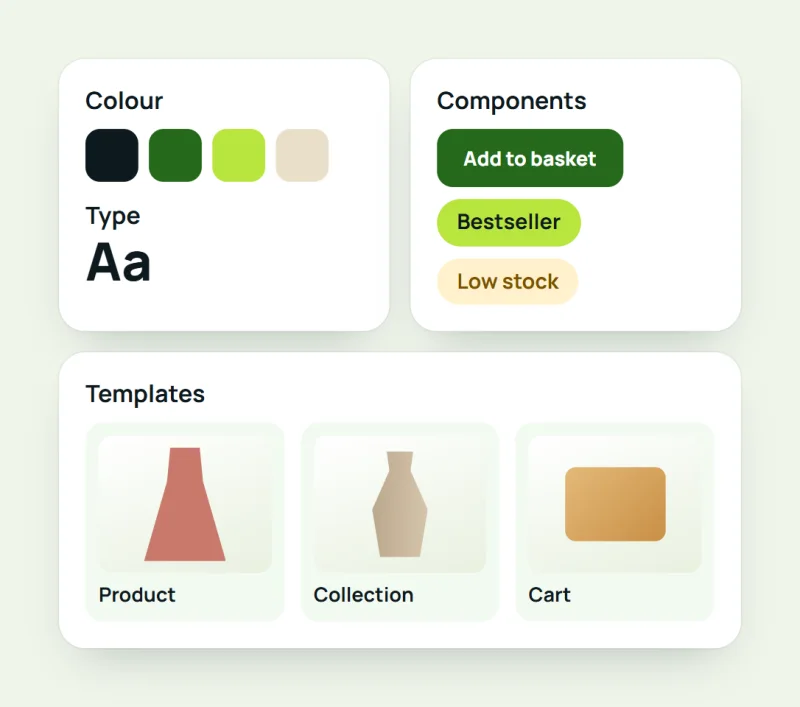
Your products might be excellent, but shoppers judge your store in a few seconds, often on a phone during a commute or a lunch break. As part of our wider shopify development services, our design work closes the gap between how strong your brand is and how your store actually feels to use. The warning signs are familiar: a homepage that says very little, menus that bury bestsellers, product pages that leave sizing or delivery questions unanswered and a basket that feels like an afterthought.
A theme straight out of the box can look polished in a demo yet feel generic next to your competitors. Patching it with app after app slows pages down and blurs your identity. Thoughtful design gives every page a clear job, from building trust with first-time visitors to moving returning customers confidently towards checkout.
Who our store design service is for
- DTC brands whose store no longer matches the quality of their products or packaging.
- Founders launching a new label who want to look established from day one.
- Retailers whose mobile visitors browse plenty but rarely buy.
- Marketing teams who need flexible landing pages without booking a developer each time.
What our Shopify web design service includes
Each deliverable is shaped by your goals, your customers and your catalogue, then reviewed by a senior designer before it reaches you. You approve every screen before development begins.
Discovery and customer insight
We start with your analytics, reviews, customer service questions and competitor stores to understand why people buy from you and what makes them hesitate. Those findings become a written design brief, so every layout decision on your new store has a clear commercial reason behind it.
UX audit of your current store
If you already trade on Shopify, we walk through your store as a shopper would, on mobile and desktop, flagging friction in navigation, search, product pages and the basket. You receive a prioritised list of fixes, ranked by likely impact and effort, rather than vague opinions.
Navigation and site structure
Menus, collection groupings and filters are planned around how your customers actually shop, whether that is by occasion, room, skin type or size. A clear structure helps visitors and search engines find your bestsellers quickly, and leaves room for new ranges as you grow.
Wireframes for key templates
Simple wireframes map the content and hierarchy of your homepage, collection, product, basket and content pages before any styling starts. It is the cheapest stage to change your mind, so we welcome plenty of debate here before pixels are polished.
Brand-led visual design
Typography, colour, imagery style, icons and buttons are designed as one consistent system in Figma. Your store should feel like your packaging, your social channels and your unboxing experience, not a lightly recoloured template.
Product pages that answer questions
We design galleries, variant pickers, size guides, delivery and returns messaging, reviews and cross-sells, giving shoppers the confidence to add to basket without leaving the page to hunt for answers or message your team.
Mobile-first layouts
Every template is designed for small screens first, with thumb-friendly controls, sticky add-to-basket buttons and quick-loading imagery, then scaled up thoughtfully for tablet and desktop so larger screens feel generous rather than stretched.
Accessibility built in
Colour contrast, focus states, readable type sizes and clear form labels are designed to WCAG 2.2 AA, so more people can shop with you comfortably, whatever device, browser or assistive technology they rely on.
Landing pages and campaign templates
Reusable layouts for launches, gift guides and seasonal moments such as Black Friday or Mother's Day let your marketing team build new pages in the theme editor in minutes, without waiting for a developer to become free.
Photography and content direction
We advise on the product shots, lifestyle imagery and copy each template needs, with recommended image ratios and shot lists, so your photographer and copywriter produce assets that fit the design first time.
Developer-ready handover
Designs are annotated with spacing, states and behaviour, then mapped to Online Store 2.0 sections and blocks, so the build matches the approved screens precisely and your team can edit content confidently after launch.
From first brief to live design: your roadmap
A typical store design project moves through four stages. Your fixed quote confirms the timings once we have seen your catalogue, content and integrations, so treat these as stages rather than promised dates.
Stage 1
Discover and define
- NDA signed, then your analytics, customer reviews and competitor stores studied closely to pinpoint what helps or stops people buying.
- Goals, must-have features and success measures captured in a short design brief that you sign off.
Stage 2
Structure and wireframes
- Site map, navigation, collection structure and filters planned around the way your customers actually search for products.
- Wireframes for key templates shared as a clickable prototype for one consolidated round of feedback.
Stage 3
Visual design
- Brand styling applied to mobile and desktop screens, backed by a reusable design system in Figma that grows with your range.
- Every screen checked by a second designer for consistency, accessibility and conversion basics before you review it.
Stage 4
Build, test and launch
- Approved designs built as editable Online Store 2.0 sections, then tested on real phones, tablets and desktop browsers.
- Go-live checklist completed, followed by a recorded walkthrough showing your team how to edit every page.
Stages, not fixed durations. Timings are agreed with you once the scope is clear.
Our store design process and timeline
Our ten-step delivery system sits behind every design project. These are the six moments you will notice most as a client, from first conversation to life after launch.
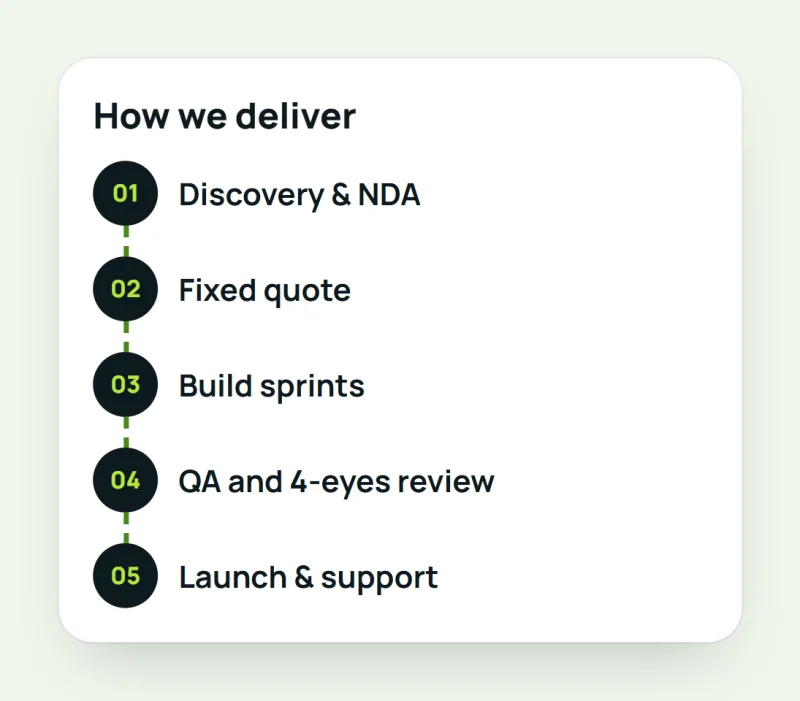
Discovery call and NDA
We sign an NDA before you share analytics or customer data, then agree goals, scope, access and the decisions that matter most to your brand.
Fixed quote and plan
You receive a Starter, Growth or Custom proposal with a fixed price and an indicative timeline, plus a dedicated project manager to keep it on track.
Design sprints
Designers work in one- to two-week sprints, sharing wireframes and then full designs as clickable Figma prototypes you can test on your own phone.
Review and sign-off
Each milestone comes with a recorded walkthrough and a single consolidated feedback round, so decisions stay quick, focused and nobody on your team drowns in endless comment threads.
Build and quality checks
Developers turn approved screens into editable sections. Checklists, a four-eyes review and lead sign-off all happen before you see the staging link.
Launch and weekly reporting
We go live against a checklist with a rollback plan, send weekly updates, then offer SLA support for changes, campaigns and seasonal refreshes.
Design tools and integrations we rely on
Good design decisions come from evidence and careful testing, not guesswork. These are the tools behind our research, prototyping and quality checks, plus the platforms your new design needs to work alongside from launch day onwards.
Figma
Wireframes, prototypes and your design system live in one shared Figma file, so you can comment directly on screens and developers build from the same source.
Microsoft Clarity and Hotjar
Heatmaps and anonymised session recordings show where shoppers click, scroll and give up, revealing usability problems that analytics reports alone simply cannot explain.
Google Analytics 4
We review device mix, landing pages and funnel drop-off before designing, then check the same reports after launch to see what has changed.
Shopify theme editor
Designs map to sections and blocks your team can rearrange, so new campaigns and content updates never depend on a developer's diary.
Real-device testing
Every template is checked on current iPhones, Android phones, tablets and desktop browsers, catching layout quirks before your customers ever see them.
Review apps
Judge.me, Okendo and Yotpo widgets are styled to match your design rather than bolted on, keeping product pages consistent and trustworthy.
How AI sharpens your store design
AI is no substitute for a designer who understands your customers and your market, but used carefully it gives us faster insight during the project and gives your team better tools once the store is live. Here is where it genuinely earns its place in a design engagement.
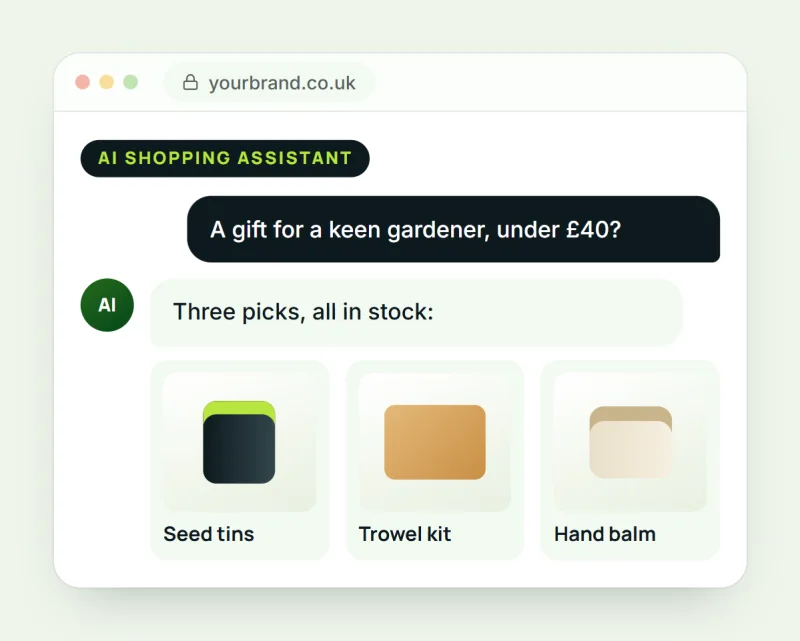
A person reviews every AI-assisted output, and your data is never used to train AI models. To see how AI could support your wider trading, from on-site search to customer service, visit our AI for Shopify Stores hub.
- Faster research: AI helps us group hundreds of reviews and support questions into clear themes, such as sizing doubts or delivery worries, which then shape product page content and layout.
- Consistent imagery: Shopify Magic can remove or replace product image backgrounds in the admin, helping your catalogue photography stay consistent with the new design without booking a fresh shoot for every product.
- First-draft copy: Shopify Magic also drafts product and collection copy from your notes, which our copywriter edits for accuracy, tone of voice and UK spelling.
- AI-ready product pages: Clear structure, accurate attributes and well-written descriptions help AI shopping assistants and AI-powered search understand and recommend your products.
App stack
Build an app stack that suits your design
Apps add useful features, but each one brings extra scripts and styling to manage. We choose a small, well-supported set that fits your design system, then style every widget to match so the store feels like one brand.
Popular tools by job
Tool names are examples; trademarks belong to their owners.
Reviews and user content
Star ratings, photo reviews and customer questions placed exactly where they reassure shoppers most, styled to look native to your store.
- Judge.mePhoto reviews with flexible widgets
- OkendoReviews, UGC and attribute ratings
Search and filtering
Fast, forgiving search and filters that reflect how customers describe your products, not how your stock system happens to name them.
- Shopify Search & DiscoveryNative filters, synonyms and boosts
- Boost AI Search & FilterAdvanced filtering for larger catalogues
Upsells and personalisation
Recommendations, bundles and basket add-ons designed into the layout from the start, so they feel helpful rather than pushy.
- RebuySmart cart and personalised recommendations
- Shopify BundlesFixed bundles sold as one product
Email capture
Sign-up forms and pop-ups that match your brand and appear at sensible moments, rather than the second someone lands on your homepage.
- KlaviyoBranded forms feeding email and SMS flows
- Shopify FormsFree sign-up forms for Shopify Email
Shopify store design pricing
Every store design project is a fixed one-off fee, ex VAT, so you know your full investment before the first wireframe is drawn. Compare the full shopify website cost picture, including migration and support, on our pricing page.
Starter
From £1,995 one-off, ex VAT
Best for: Theme-based store, styled and adapted to your brand.
What it covers:
- Premium theme selected and customised
- Mobile-first styling of key templates
- Accessibility and real-device testing
Growth
From £4,995 one-off, ex VAT
Best for: Custom design store, crafted in Figma around your customers.
What it covers:
- Research, wireframes and full visual design
- Bespoke Online Store 2.0 sections
- Design system and editing walkthrough
Custom
Get a quote
Best for: Large ranges, multiple markets or complex features. Get a quote.
What it covers:
- Scope defined during discovery
- Fixed quote before work begins
- Dedicated PM and design lead
Fixed prices, agreed before work starts. All prices exclude VAT.
Compare every service on our Shopify pricing page.
See our design work live, without breaking any NDA
- NDA signed before any data is shared
- Least-privilege access with 2FA
- UK GDPR and data processing terms
- Your data never trains AI models
Brands share unreleased collections, pricing plans and customer data with us during a design project, so every engagement is protected by a non-disclosure agreement. That is why this page shows no client logos or before-and-after screenshots, and why your designs would never appear in someone else's pitch.
Instead, we show you our work properly, in real time and with a real person. On a live screen-share over Zoom or Google Meet, a designer walks you through real Figma files, design systems, prototypes and annotated handovers, with confidential details hidden. Ask how we approached a tricky navigation, a complex product page or a seasonal campaign template, and we will show you the thinking as well as the finished screens.
Your own information gets the same protection. We sign an NDA before anything is shared, agree non-solicit terms, use least-privilege access with two-factor authentication and work in line with UK GDPR. Client data is never used to train AI models, and it is deleted at the end of the contract unless you ask us to return it. Book a Live Walkthrough and judge our design standards for yourself.
How much does Shopify web design cost in the UK?
Our store design projects start from £1,995 ex VAT for a theme-based store and from £4,995 ex VAT for a custom design store, both as one-off fixed fees. Larger catalogues, multiple markets or complex features are quoted individually after discovery, and you always see the full price before any work starts.
Can you design just part of our store, such as product pages?
Yes. Not every brand needs a full redesign. If your analytics show the problem sits on product pages, collections or the basket, we can design and build those templates on their own, matched to your existing style. It is a cost-effective way to fix the biggest leaks first and plan wider changes later.
Can you redesign our store without losing sales or SEO?
Yes. We design and build on an unpublished theme, so your live store keeps trading throughout. Page titles, structured data and URLs are protected, any changed URLs receive redirects, and we publish at a quiet time agreed with you, with a rollback plan ready in case anything unexpected happens.
Will we be able to edit the new design ourselves?
That is the whole point. We build designs as Online Store 2.0 sections and blocks, so your team can change images, text, products and page layouts in the theme editor. At handover you also get a recorded walkthrough and a short guide covering the edits you are most likely to make.
Do you design for mobile first?
Always. We design the mobile version of every template first, because that is where many UK shoppers discover new brands, then adapt it for tablet and desktop. Buttons are thumb-friendly, key information sits near the top of the screen and imagery is sized to load quickly over phone connections.
How do you make sure the design actually converts?
We base decisions on evidence: your analytics, heatmaps, reviews and customer service questions. Proven ecommerce patterns, such as clear delivery messaging, visible reviews and simple variant selection, are adapted to your brand. After launch we review the same data, so you can see what has improved and what to test next.
Is accessibility included in your store design?
Yes. We design to WCAG 2.2 AA as standard, covering colour contrast, keyboard navigation, focus states, alt text and form labels. That makes your store easier for everyone to use and supports your responsibilities under UK equality law. If you sell into the EU, it also helps with the European Accessibility Act.
What do you need from us to get started?
Your brand guidelines, logo files, product photography, analytics access and a few brands you admire. If something is missing, such as photography or a style guide, we will advise on what to commission. Your project manager shares a clear list of inputs, owners and deadlines at kick-off.
Ready for a store that looks as good as your products?
Share a link to your current store, your brand guidelines and your growth goals, and we will reply with a fixed Starter, Growth or Custom quote, a clear design plan and a dedicated project manager who keeps everything moving from first wireframe to launch day.
Free consultation
Get a fixed quote for shopify Store Design
Share your details and a member of our team will follow up to arrange a brief discussion.
Tell us about your project
What happens next
- You send your store and project details.
- We follow up to arrange a short call.
- On the call, we talk through your goals and explain how we would scope the work.
Talk to us directly
Waverley House, 9 Noel St, London W1F 8GQ
Phone +44 7476 560011 WhatsApp +44 7476 560011 (opens in new tab) Email hello@shopifyagencylondon.co.ukPrefer the full contact page? Visit our Contact / Free Consultation page.