
Custom Shopify themes
Shopify Theme Development That Is Fast, Flexible and Yours
Bespoke Liquid themes built for speed, easy editing and the way your brand sells.
Our Shopify theme development service gives UK brands a theme engineered around their products and customers, with reusable sections, structured content and clean Liquid code in place of a pile of app widgets and hurried patches. Every theme is built on Online Store 2.0, tested on real devices and handed over with full documentation, so your marketing team can launch new pages and seasonal campaigns confidently and your store stays quick as your range and traffic grow.
Prefer to talk? Call +44 7476 560011 or message us on WhatsApp (opens in new tab)
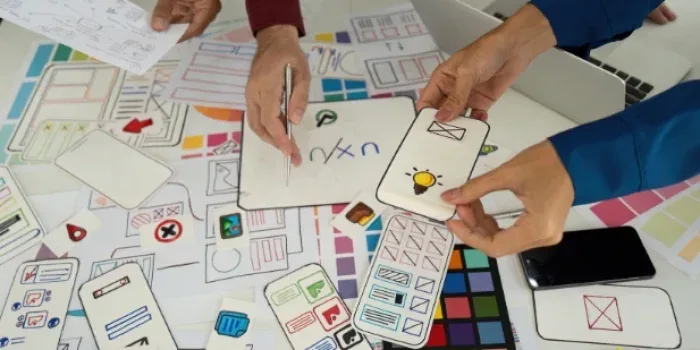
When an off-the-shelf theme stops fitting your brand
Premium themes are a brilliant starting point, and as part of our shopify development services we often recommend one. Trouble starts when a brand's needs outgrow what the theme was ever designed to do, usually right as the business is gaining momentum. Teams begin bolting on apps for basic layout features, editing code directly in the live theme and avoiding theme updates because past customisations might break something nobody remembers changing.
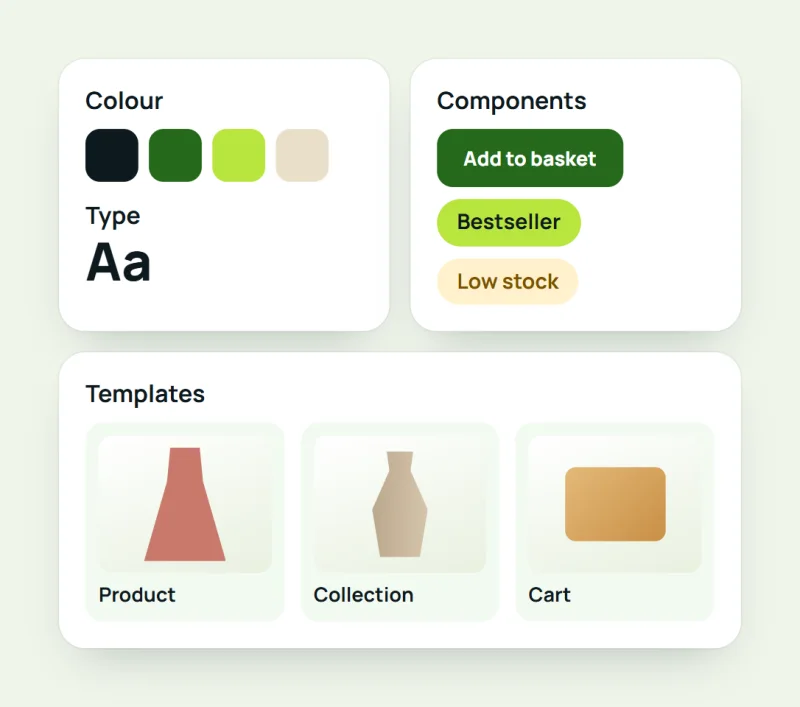
The result is a store that gets slower, harder to edit and riskier to change every season. A purpose-built theme, or a carefully extended one, puts the features you rely on into maintainable, documented code, with sections your team can use without fear of breaking the layout before a big campaign.
Who a custom theme suits
- Brands whose catalogue, bundles or product options simply do not fit a standard theme.
- Teams still running a vintage theme without Online Store 2.0 sections on every page.
- Stores weighed down by apps that only exist to add layout features such as tabs, badges or size charts.
- Agencies and in-house teams who need a clean, documented codebase to build on for years.
What our Shopify theme development includes
Every theme we deliver is planned, coded and reviewed by dedicated Shopify specialists, with performance and ease of editing treated as firm requirements from the very first commit rather than optional extras.
Theme audit and recommended approach
We review your current theme, apps, page speed and editing pain points, then recommend whether to extend a premium theme or build a custom one, with clear reasoning, risks and costs behind the choice so you can decide with confidence.
Online Store 2.0 architecture
JSON templates and flexible sections let your team add, reorder and remove content on any page, from the homepage and landing pages to individual product templates, without raising a ticket or waiting days for a developer to become available.
Bespoke section and block library
We build a library of on-brand sections, such as feature grids, comparison tables, lookbooks and FAQs, each with sensible settings, previews and guardrails that stop layouts breaking when content, images or copy lengths change.
Product page engineering
Variant pickers, colour swatches, bundles, size guides, stock messages, delivery estimates and personalisation fields are coded natively wherever possible, keeping your most important pages fast, stable and easy to update as your range evolves.
Metafields and dynamic sources
Specifications, ingredients, care details and badges are pulled from metafields and metaobjects, so content is entered once in the admin and appears consistently across every relevant template, filter and feed.
Clean app integration
Reviews, subscriptions, loyalty and upsell apps slot in through theme app extensions and app blocks, avoiding messy code injections that slow pages down, clash with your styling and are hard to remove later.
A strict performance budget
We keep JavaScript light, lazy-load images, serve responsive image sizes and avoid render-blocking resources, testing Core Web Vitals on real templates throughout the build rather than once at the very end.
Accessible, semantic markup
Logical heading structure, keyboard-friendly menus and pop-ups, visible focus states and properly labelled controls are built in from the start and checked against WCAG 2.2 AA, so more customers can shop comfortably.
Vintage theme upgrades
Older themes are rebuilt on Online Store 2.0, with existing content and layouts carried across carefully, unlocking sections on every page and modern app blocks without losing what already works.
Translation-ready for new markets
All storefront text is stored in locale files rather than hard-coded, so translations and regional content for Shopify Markets can be added later without rewriting templates, ready for EU or US expansion.
Documentation and editor training
You receive a theme guide covering every section and setting, plus a recorded walkthrough, so new staff, freelancers and future developers can work with the theme confidently long after launch.
Custom Shopify Theme vs Premium Theme
Still weighing up your options? Our in-depth guide compares cost, flexibility, speed, ownership and long-term upkeep to help you decide which route really suits your brand, team and budget.
Your theme development roadmap
Whether you need a fresh custom theme or a careful rebuild, theme projects usually move through four stages. Your fixed quote confirms the timeline once we know how many templates and sections you need and whether any app or data dependencies affect the build.
Stage 1
Audit and specification
- NDA signed, then your current theme, installed apps and analytics reviewed, with every editing frustration your team has recorded.
- Section library, templates, content models and performance targets defined in a written specification that you approve.
Stage 2
Foundations
- GitHub repository created, coding standards agreed and the base layout, typography, colour tokens and core components built.
- Development theme connected to your store, so you can watch progress on a private preview link at any time.
Stage 3
Templates and sections
- Homepage, collection, product, cart and content templates assembled from reusable, configurable sections.
- Required apps connected through app blocks, and structured content models set up with metafields and metaobjects.
Stage 4
Test, launch and hand over
- Device, browser, accessibility and speed testing completed by a second developer, then your own review on a staging theme.
- Theme published against a launch checklist at a quiet time, with documentation and a recorded editor walkthrough supplied.
Stages, not fixed durations. Timings are agreed with you once the scope is clear.
Our theme build process
Our ten-step delivery system keeps every theme build predictable and transparent. These six stages are the ones you will experience most directly as a client, whatever the size of your project.
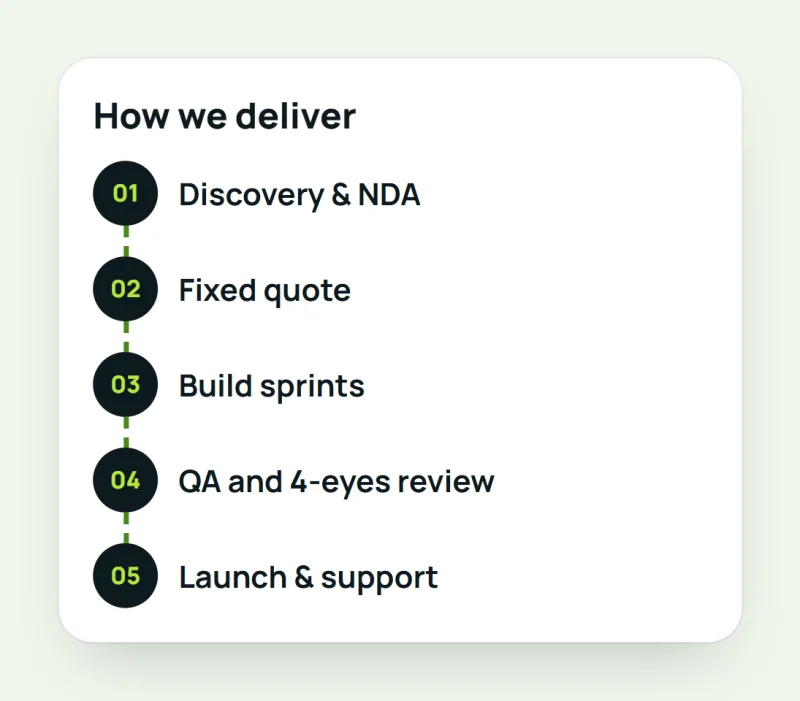
Confidentiality and discovery
Once the NDA is signed, we study your brand, products, analytics and current theme, then agree scope, goals and the access our developers need.
Specification and fixed price
A written specification lists every template and section, with a fixed price and indicative timeline attached to your chosen Starter, Growth or Custom tier.
Coding in short sprints
Developers build in focused sprints from a shared GitHub repository, demoing finished sections as they go so you can give feedback early.
Peer review and testing
Each pull request is reviewed by a second developer, then tested for speed, accessibility and device quirks before a lead signs it off.
Your approval
You review the templates on a preview theme alongside a recorded walkthrough, sending one consolidated set of feedback for each milestone.
Launch and aftercare
We publish at an agreed quiet time with a rollback plan ready, report on progress and offer SLA support for new sections, fixes and updates.
The tools behind our theme builds
Professional theme development relies on proper tooling, version control and automated checks. These are the tools that keep our code consistent, reviewable and fast, and that protect your live store while we work.
Shopify CLI
Shopify's command-line tool lets our developers preview changes locally against your real store data and push to development themes, without ever touching the theme your customers see.
GitHub and Shopify's GitHub integration
Your theme lives in a repository with a full change history, and Shopify's GitHub integration keeps connected themes in step with the chosen branch.
Theme Check
Automated linting flags Liquid errors, performance problems and deprecated code before a human reviewer even opens the pull request, keeping standards consistent.
Lighthouse and PageSpeed Insights
Performance and accessibility are measured on key templates throughout the build, not just in the final week before launch, so problems are fixed while they are still cheap.
Theme Access app
Shopify's Theme Access app gives developers secure, theme-only credentials, so nobody needs wider admin rights simply to work on your code.
Figma
Designs and component specifications come straight from Figma, keeping spacing, typography and interactive states identical between design and code.
AI and the future of Shopify themes
Shopify keeps adding AI features to the admin, and a modern theme should be built with that direction in mind. We use AI where it genuinely helps and keep experienced developers firmly in charge of quality, security and maintainability.
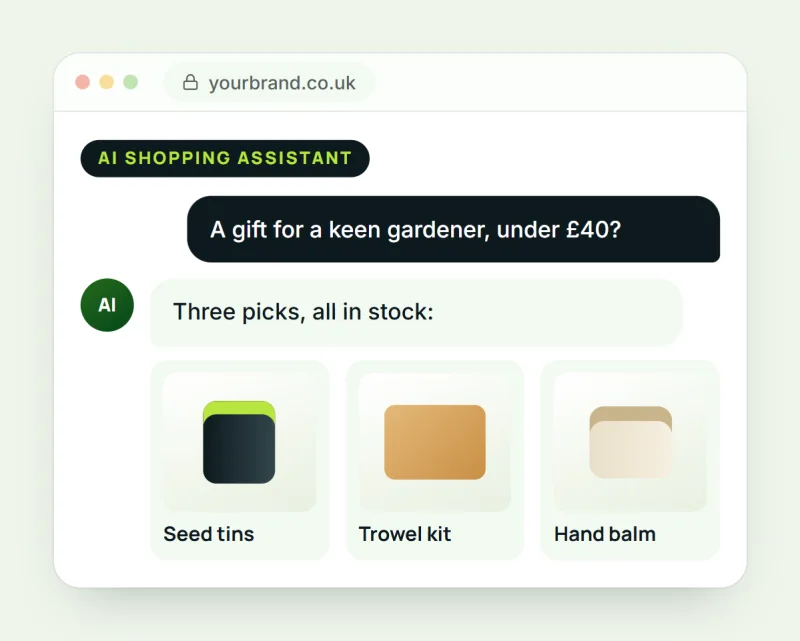
No client data is used to train AI models, and AI never ships code to your store without a human review and test. Discover the wider opportunities for your store on our AI for Shopify Stores hub.
- Faster routine coding: where AI coding assistants speed up boilerplate or test cases, a developer still reviews, runs and takes responsibility for every change that enters your repository.
- Room for AI-drafted content: sections built around metafields work neatly with Shopify Magic drafts, so AI-assisted copy slots into your layouts without breaking them or bloating pages.
- Machine-readable product pages: clean, semantic markup and accurate structured data help AI-powered search and AI shopping assistants understand your products correctly.
- Clear naming for your team: sensibly named sections and settings make the theme editor easier to navigate for every member of staff, whoever is editing that day, and reduce the risk of the wrong block being changed.
App stack
Apps that work with your theme, not against it
A custom theme removes the need for many layout apps, but some specialist tools are still worth keeping. We favour apps that support app blocks, so they can be added, moved or removed cleanly without leftover code.
Popular tools by job
Tool names are examples; trademarks belong to their owners.
Reviews and ratings
Reviews placed through app blocks inherit your theme's typography and spacing, so they never look like an awkward add-on.
- Judge.meLightweight reviews with app blocks
- OkendoReviews with fit and attribute ratings
Loyalty and rewards
Points, tiers and referral programmes that live naturally inside your design, from account pages to product page messaging.
- LoyaltyLionLoyalty programmes with on-site widgets
- Smile: Loyalty & RewardsPoints and referrals for growing teams
Bundles and upsells
Cart and product page offers that respect your layout, your brand voice and your loading speed, even on older phones.
- RebuyPersonalised upsells and a smart cart
- Shopify BundlesNative fixed bundles and multipacks
Search and filtering
Instant search and collection filters styled to match your theme, helping shoppers narrow large ranges in a few taps.
- Boost AI Search & FilterFilters, merchandising and instant search
- Shopify Search & DiscoveryNative filters and product boosts
Shopify theme development pricing
Theme projects are fixed one-off fees, quoted ex VAT and agreed before coding begins, so scope creep never turns into a surprise bill. Our pricing page sets out the shopify website cost for every service in one place.
Starter
From £1,995 one-off, ex VAT
Best for: Theme-based store, extended with custom sections and styling.
What it covers:
- Premium theme set up and tailored
- Custom sections for key pages
- Speed and accessibility checks
Growth
From £4,995 one-off, ex VAT
Best for: Custom design store on a bespoke Online Store 2.0 theme.
What it covers:
- Theme coded from your approved designs
- Reusable section and block library
- Theme guide and editor training
Custom
Get a quote
Best for: Complex themes, several stores or vintage rebuilds. Get a quote.
What it covers:
- Specification agreed in discovery
- Fixed price before coding starts
- Lead developer and dedicated PM
Fixed prices, agreed before work starts. All prices exclude VAT.
Compare every service on our Shopify pricing page.
See our theme code on a live call
- NDA signed before any data is shared
- Least-privilege access with 2FA
- UK GDPR and data processing terms
- Your data never trains AI models
The themes we build carry our clients' product plans, pricing logic and brand assets, so every project sits under a non-disclosure agreement. You will not find client theme names, store links or performance results on this site, and your own theme will never be reused for, or shown to, another brand.
What we can offer instead is a proper look under the bonnet, with your questions answered in real time. On a live screen-share using Zoom or Google Meet, a lead developer will take you through real section libraries, GitHub pull requests, Theme Check reports, speed testing and theme documentation, with anything identifying hidden. Bring the frustrations you have with your current theme, and we will show you exactly how we would approach them.
Your access and data are handled with the same care. The NDA is signed before anything is shared, non-solicit terms are agreed, access is least-privilege with two-factor authentication, and we work to UK GDPR. Client data never trains AI models and is deleted at contract end. Book a Live Walkthrough to see the quality of our code first-hand before you choose a partner.
Is a custom theme better than a premium theme from the Shopify Theme Store?
Not always. Premium themes are well supported and suit many brands perfectly. A custom theme earns its cost when you need specific features, a distinctive layout or leaner code than a multipurpose theme allows. Our guide to custom versus premium themes covers the trade-offs, and we give an honest recommendation after reviewing your store.
What does Online Store 2.0 mean for our theme?
Online Store 2.0 is Shopify's modern theme architecture. It brings sections to every page, JSON templates, app blocks and dynamic content from metafields. In practice, your team can build and rearrange pages without code, apps install cleanly and specialised templates, such as a different layout for gift sets, become simple to create.
Can you upgrade our vintage theme without starting again?
Often, yes. We rebuild the theme's templates as Online Store 2.0 sections, carry across your existing styling and content, and replace hard-coded customisations with editable settings or metafields. Where the old code is too tangled to rescue, we explain why and quote for a cleaner rebuild instead.
Will our existing apps still work with a new theme?
Most modern apps support app blocks or theme app extensions and connect cleanly. Older apps sometimes inject code straight into theme files, so we audit every app first, reconnect the ones you need properly and recommend removing any that a native theme feature can now replace.
How do you keep a custom theme fast?
We set a performance budget at the start, keep JavaScript minimal, use Shopify's responsive image handling and lazy loading, and avoid loading app scripts on pages that do not need them. Speed is checked throughout the build with Lighthouse, so slow code is caught before launch rather than after it.
Can the theme gain new features after launch?
Yes. Because a custom theme is yours, it evolves on your schedule rather than a vendor's release cycle. When Shopify introduces new theme capabilities, we assess what is genuinely useful for your store and add it through a support plan, tested on a preview theme first.
Who owns the theme once it is built?
You do. The theme is published in your Shopify store, the code sits in a GitHub repository you control, and documentation is included at handover. There are no licence fees for a bespoke theme, and any developer you choose in future can pick it up and continue.
Can you work alongside our in-house developers?
Absolutely. We can share a repository, agree coding standards and review each other's pull requests, or take ownership of specific sections while your team handles others. Clear branching, documentation and weekly updates keep everyone aligned, so nothing gets overwritten when two teams work on one theme.
Ready for a theme built around your brand?
Send us a link to your current store and your feature wish list, and we will come back with a fixed Starter, Growth or Custom quote, a clear specification and a lead developer ready to build a theme your team will genuinely enjoy using every day.
Free consultation
Get a fixed quote for shopify Theme Development
Share your details and a member of our team will follow up to arrange a brief discussion.
Tell us about your project
What happens next
- You send your store and project details.
- We follow up to arrange a short call.
- On the call, we talk through your goals and explain how we would scope the work.
Talk to us directly
Waverley House, 9 Noel St, London W1F 8GQ
Phone +44 7476 560011 WhatsApp +44 7476 560011 (opens in new tab) Email hello@shopifyagencylondon.co.ukPrefer the full contact page? Visit our Contact / Free Consultation page.