
Custom Shopify apps
Shopify Application Development for Growing UK Brands
Custom apps, extensions and automations that remove the limits holding your Shopify store back.
Our Shopify application development team builds custom apps, admin tools, checkout extensions and Shopify Functions for UK merchants who have outgrown off-the-shelf apps, monthly app bills and manual workarounds, so your store finally runs the way your business works. Every build is scoped at a fixed price, delivered in short sprints under NDA, checked by a second developer before you see it and handed over with clear documentation your in-house team can actually use.
Prefer to talk? Call +44 7476 560011 or message us on WhatsApp (opens in new tab)

When apps and workarounds stop scaling
Most Shopify stores start life with a theme and a handful of App Store installs. That works brilliantly, right up until it doesn't. Whether you already use our shopify development services or another partner, the warning signs look the same: several apps doing overlapping jobs, a spreadsheet someone updates every Monday morning, and a checkout rule nobody can change without a developer on call.
The cost of standing still is easy to miss. Every manual step slows dispatch, every extra app adds script weight and another monthly invoice, and every workaround depends on one person remembering exactly how it works.
Shopify application development closes the gaps that public apps were never designed to cover. A custom app talks to your store through Shopify's official APIs, does one job properly and follows your roadmap rather than a vendor's.
Who custom app development is for
And if a well-supported app already does the job, we will say so plainly and save you the build budget.
- UK DTC brands paying for several subscriptions to solve a single workflow
- Merchants whose pricing, bundling or fulfilment rules standard settings cannot express
- Operations teams re-keying data between Shopify and other business systems
- Founders and SaaS teams planning a public app for the Shopify App Store
What's included in our Shopify app builds
Every engagement is scoped to the problem in front of us, but these are the building blocks we reach for most often. Your fixed quote lists exactly which ones apply to your project and why.
Custom apps for your store
Apps built for one store or organisation, installed directly and never listed publicly. We use Shopify's official app framework and the GraphQL Admin API, which suits internal workflows, data enrichment and business rules nobody else shares. A London gift brand, for example, could send personalised engraving instructions straight to its workshop queue.
Public apps for the App Store
Planning to sell an app to other merchants? We build to Shopify's App Store requirements, including the mandatory privacy webhooks, billing through Shopify's Billing API and a review-ready listing. We then work through reviewer feedback alongside you and plan the support model you will need once real merchants start installing.
Theme app extensions
App blocks and app embeds let your merchandisers place app features in the theme editor without touching code. They keep themes tidy, uninstall cleanly and cope with theme updates far better than injected snippets, which matters when your marketing team switches templates before every seasonal campaign.
Shopify Functions
Custom discount logic, delivery and payment rules, and cart validation that run on Shopify's own infrastructure at checkout speed. Think hiding next-day delivery for oversized furniture, offering tiered bundle discounts or stopping checkout when a trade minimum is missed. Some function types depend on your Shopify plan, which we confirm at discovery.
Checkout and post-purchase extensions
Checkout UI extensions add fields, offers, delivery notes and trust messages to checkout, thank-you and order status pages. Extensions on the main checkout steps need Shopify Plus, while thank-you and order status pages are open to other plans too, so there is usually something valuable to build whatever plan you are on.
Admin tools and dashboards
Embedded app pages and admin UI extensions put the tools your team needs inside Shopify admin, styled with Polaris so they feel native. Bulk tagging, approval queues, returns triage or a pick-and-pack screen for the warehouse all fit here, cutting the tab-switching that slows busy customer service and operations teams.
Webhooks and data sync
Apps that listen for Shopify events and pass clean, validated data to your ERP, 3PL, CRM or data warehouse. Built with retries, rate-limit handling and detailed logging, so a busy Black Friday weekend never leaves orders stranded in a queue and your team can trace any record from source to destination.
Security, QA and handover
Least-privilege API scopes, encrypted secrets and UK GDPR-aware data handling come as standard on every build. Each release passes a 4-eyes code review, you test on a staging install first, and SLA support options keep the app healthy, patched and compatible long after launch day. Documentation covers setup, environment variables and known limits, so nothing lives only in one developer's head.
Your app launch roadmap
How a typical custom app travels from first idea to live store. Exact timings depend on scope and are fixed in your quote before any work begins, so you always know what comes next.
Phase 1
Discovery and specification
- NDA signed, current workflows mapped and the build-versus-buy question answered honestly before a single line of code is written.
- Data model, API scopes, screens and success measures agreed in a written specification that you review and sign off.
Phase 2
Prototype and build
- A clickable admin prototype comes first so your team can react early, followed by sprint-based development on a dedicated development store.
- Weekly updates track progress against milestones, with blockers and scope questions raised the moment they appear rather than at the end.
Phase 3
Test and review
- Automated and manual testing, a 4-eyes code review and lead developer sign-off happen before anything reaches you.
- You test real scenarios, such as refunds, bundles and edge-case orders, on a staging install and return one consolidated round of feedback.
Phase 4
Launch and support
- We install on your live store using a go-live checklist, with a tested rollback plan ready if anything misbehaves.
- Monitoring, monthly reporting and SLA support keep the app reliable as Shopify releases new API versions and features.
Stages, not fixed durations. Timings are agreed with you once the scope is clear.
How we deliver Shopify application development
Our ten-stage delivery process, condensed into the six moments that matter most to you as the client, from first conversation to long-term support.
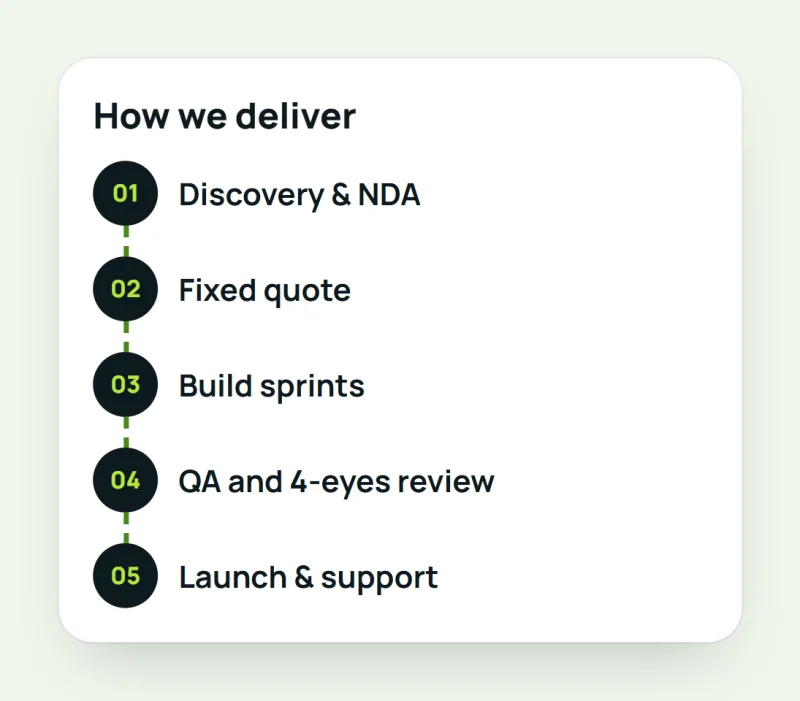
Discovery and NDA
We sign an NDA before any data changes hands, then agree goals, store access and scope. You leave knowing whether a custom app is genuinely the right answer for your problem.
Fixed quote
You receive a Starter, Growth or Custom proposal with a fixed price and timeline, so budget conversations happen once rather than every sprint.
Secure onboarding and planning
Access is granted on a least-privilege basis through a password manager with 2FA and an access log. Your project manager then sets milestones, owners and a clear RACI.
Sprints and quality checks
Specialists build in one-to-two-week sprints with daily internal stand-ups. Each release passes checklists, a 4-eyes review and lead sign-off before you see it.
Review and go-live
You test on staging, supported by recorded walkthroughs, and give one feedback round per milestone. We then launch with a rollback plan ready.
Reporting and support
Weekly updates and a monthly KPI report keep you informed. SLA support follows launch, and offboarding removes our access and returns or deletes your data.
Tools and APIs we build with
We stick to Shopify's supported, documented tooling, so your app keeps working when the platform moves on and any competent developer can pick it up later.
Shopify CLI and app templates
Shopify's official command-line tool scaffolds the app, runs local development and deploys extensions through one consistent, repeatable workflow that every developer on the project shares.
GraphQL Admin API
Shopify's primary API for new apps, giving efficient access to products, orders, customers, metafields and bulk operations, even on catalogues with tens of thousands of variants.
Polaris and App Bridge
Shopify's design system and embedding library make your app look and behave like part of Shopify admin, on desktop and on the Shopify mobile app.
Shopify Flow
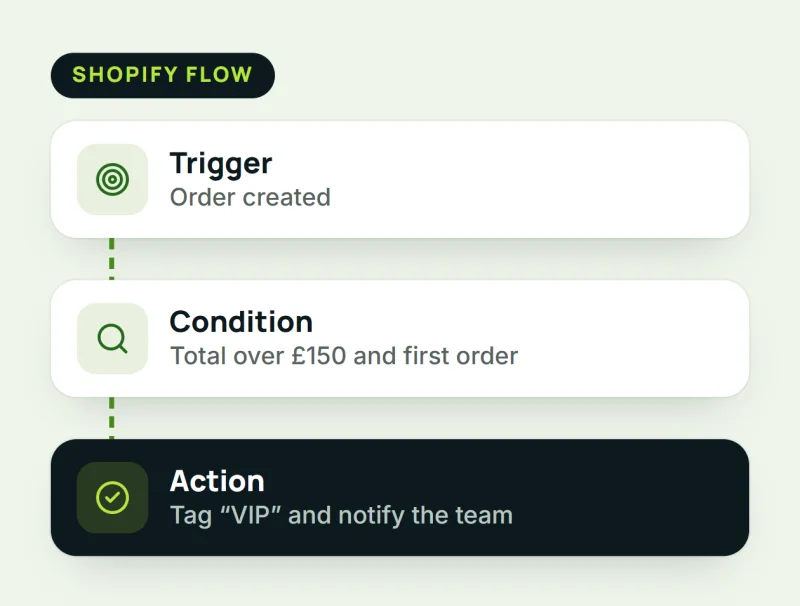
Custom Flow triggers and actions let non-developers automate around your app, from tagging high-value orders to alerting the warehouse team the moment stock runs low.
Metafields and metaobjects
Structured custom data stored natively in Shopify, editable by your team and usable across themes, checkout and the Storefront API without extra databases.
Storefront API
Powers custom shopping experiences, headless front ends and in-store kiosks from the same product, price and inventory data your online store already uses.
Where AI fits in a custom Shopify app
AI now appears in plenty of app briefs, and it earns its place when it removes repetitive work rather than adding novelty. We build AI features into custom apps where the business case is clear: drafting product copy for your team to approve, summarising long customer emails before they reach support, tagging orders by intent or flagging unusual refund patterns for a human to check.
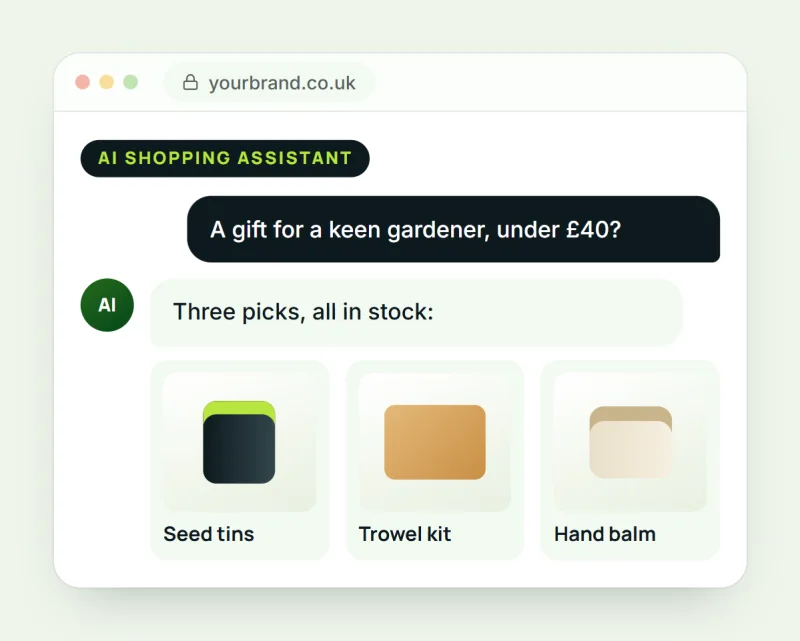
Before writing any AI code, we check whether Shopify's built-in tools already cover the need. Shopify Magic and Sidekick handle a surprising number of admin tasks, and our hub on AI for Shopify Stores explains where they stop and custom work begins.
How we keep AI features safe
The result is AI that gives your team time back every week without putting brand voice, customer trust or UK GDPR compliance at risk. When the models improve, your app can improve with them, because the AI layer is built as a replaceable component rather than hard-wired into everything else.
- Human approval on anything a customer will see
- Only the data each feature needs, sent under least-privilege scopes
- Your client data is never used to train AI models
- Clear logs showing what the model received and returned
- A simple switch to turn any AI feature off without redeploying the app
App stack
App stack builder: build or buy?
A custom app should fill genuine gaps, not duplicate proven tools. These are the apps we often keep running alongside a bespoke build, so your budget goes on what is truly unique.
Popular tools by job
Tool names are examples; trademarks belong to their owners.
Workflow automation
Many requests that start life as a custom app brief are solved with a well-designed Flow and some clean, structured data.
- Shopify FlowNative triggers, conditions and actions
- MatrixifyBulk imports, exports and scheduled data jobs
Subscriptions and retention
Your custom app can feed these platforms with richer customer events instead of trying to replace them.
- RechargeSubscription billing and customer portal
- KlaviyoEmail and SMS flows triggered by app events
Reviews and UGC
Mature review platforms already solve moderation, syndication and display, so we integrate with them rather than rebuild.
- Judge.meProduct reviews and photo reviews
- OkendoReviews, surveys and loyalty
Customer service and returns
Custom admin tools work best when they share data with the platforms your support team already lives in.
- GorgiasHelpdesk with Shopify order context
- Loop ReturnsSelf-serve returns and exchanges
Search and merchandising
A custom app can enrich product data that these tools then use to deliver sharper results and offers.
- Boost SearchSearch, filters and merchandising rules
- RebuyPersonalised upsells and cart offers
Pricing: from store build to bespoke app
Packages start with a fixed-price Shopify store and scale to fully bespoke apps, with all prices shown ex VAT. For the bigger picture on Shopify website cost, see our pricing page.
Starter
From £1,995 one-off, ex VAT
Best for: Theme-based store with proven App Store apps configured
What it covers:
- Theme set up and styled to your brand
- Core apps selected, installed and tested
- Launch checklist and team handover
Growth
From £4,995 one-off, ex VAT
Best for: Custom design store with app and data needs mapped
What it covers:
- Bespoke design and page templates
- App and integration requirements documented
- 4-eyes QA and lead sign-off
Custom
Get a quote
Best for: Bespoke custom or public app development – get a quote
What it covers:
- Scoped on a discovery call under NDA
- Fixed price agreed before build starts
- Ongoing SLA support available
Fixed prices, agreed before work starts. All prices exclude VAT.
Compare every service on our Shopify pricing page.
See our app work on a live walkthrough
- NDA signed before any data is shared
- Least-privilege access with 2FA
- UK GDPR and data processing terms
- Your data never trains AI models
Custom apps sit right on top of a merchant's most sensitive data: pricing logic, customer records and supplier terms. That is why all our client work is covered by NDA, and why you will never see client names, screenshots or results published on this site. The same protection applies to you from the very first call.
Instead of a public portfolio, we offer a live screen-share on Zoom or Google Meet. We walk you through comparable app builds with client details kept out of view, explain the architecture choices behind them and answer your technical questions in real time. Bring your developer, operations lead or finance director along; the more pointed the questions, the better.
It is also a useful way to test fit. You will see how we document decisions, how we structure code for handover and how our project managers report progress, which tells you far more than a gallery of logos ever could.
Before you share anything about your own store, we sign an NDA. Access is least-privilege with 2FA, handled in line with UK GDPR, never used to train AI models and removed at the end of the contract.
Book a Live Walkthrough and judge our Shopify application development on substance rather than sales slides.
What is the difference between a custom app and a public app?
A custom app is built for one store or organisation and installed directly, without an App Store listing. A public app is listed on the Shopify App Store for any merchant to install, so it must pass Shopify's review and meet extra requirements around billing, privacy and performance. Custom apps are usually quicker to launch because there is no review queue.
How much does a custom Shopify app cost?
It depends on scope: the number of screens, integrations and data volumes, and whether you need Shopify Functions or checkout extensions. Bespoke app work sits in our Custom tier and is quoted at a fixed price after discovery. Our guide, Building a Custom Shopify App: Process and Cost, explains what drives the budget.
Do I need Shopify Plus for a custom app?
Not for most apps, because custom apps can be installed on standard Shopify plans. Some capabilities are tied to Plus, such as checkout UI extensions on the information, shipping and payment steps, and certain Shopify Functions used in custom apps. We confirm exactly what your plan supports during discovery, before any fixed quote is issued.
How long does it take to build a Shopify app?
A focused admin tool or single Shopify Function is far quicker than a multi-system app with its own interface. You receive a timeline with your fixed quote, broken into one-to-two-week sprints with clear milestones, so you can see progress every week rather than waiting for a big reveal at the end.
Will a custom app slow my store down?
It should not. Theme app extensions load only where they are placed, Shopify Functions run on Shopify's infrastructure and most back-office logic never touches the storefront at all. We test page speed before and after launch and avoid script-heavy approaches that drag down Core Web Vitals and mobile conversion.
Can you take over an app another developer built?
Yes. We start with a code and security review covering API scopes, deprecated endpoints, error handling and hosting. You get a plain-English report on what to keep, refactor or rebuild, followed by a fixed quote for the work. Access stays least-privilege and logged throughout the review and any rebuild.
How do you handle Shopify API updates?
Shopify releases a new API version every quarter and retires older versions on a published schedule. Under an SLA support plan we track deprecation notices, update your app before versions expire and test against new releases, so changes on Shopify's side never quietly break features your team relies on.
Can you get our app approved on the Shopify App Store?
We build to Shopify's published App Store requirements, prepare the listing assets and guide you through submission and reviewer feedback. Approval is always Shopify's decision, so we plan for review readiness from the first sprint rather than treating it as a tick-box exercise at the very end.
Ready to build the app your Shopify store is missing?
Tell us about the workflow, rule or integration holding your team back and we will come back with a clear recommendation, a fixed-price quote and an honest view on whether a custom app or an existing tool is the smarter move for your store.
Free consultation
Get a fixed quote for shopify App Development
Share your details and a member of our team will follow up to arrange a brief discussion.
Tell us about your project
What happens next
- You send your store and project details.
- We follow up to arrange a short call.
- On the call, we talk through your goals and explain how we would scope the work.
Talk to us directly
Waverley House, 9 Noel St, London W1F 8GQ
Phone +44 7476 560011 WhatsApp +44 7476 560011 (opens in new tab) Email hello@shopifyagencylondon.co.ukPrefer the full contact page? Visit our Contact / Free Consultation page.