
Team marking up paper wireframes on a table

AI & Ecommerce

Agentic Commerce: Selling Through AI Shopping Assistants

Agentic commerce explained for UK Shopify brands: how AI shopping assistants pick products and how to get your store ready for them. Talk to SAL today.

In this article (4 sections)
  1. What is agentic commerce?
  2. How AI shopping assistants choose products
  3. How to prepare your Shopify store for agentic commerce
  4. What to watch, and what to ignore

Key takeaways

  • Agentic commerce describes shopping where an AI assistant does part of the work for the customer: understanding the request, searching, comparing options and, in some markets where supported, helping to complete the purchase. For Shopify brands it adds a new kind of visitor, one that reads your product data rather than your banners, and judges you on facts.
  • Assistants can only recommend what they can understand. Complete, consistent product information, such as materials, sizing, dimensions, compatibility, price, stock and delivery options, matters far more than clever headlines. Gaps and contradictions make it harder for an agent to match your products to a detailed, specific request.
  • Trust signals carry extra weight when software builds the shortlist. Clear delivery and returns policies, accurate stock, genuine reviews and transparent VAT-inclusive pricing help an assistant, and the shopper checking its suggestions, feel confident choosing you over a similar product sold elsewhere. Strong signals also reassure the people who click through.
  • This is an emerging channel, not a finished one. Which assistants can show or sell your products, in which countries and through which integrations, is still changing. Follow Shopify's own announcements and your admin rather than every headline, and avoid paying for promises nobody can yet keep, however confident the sales pitch.
  • The preparation pays off even if agentic shopping grows slowly. Better product data improves on-site search, filters, Google Shopping feeds and conversion right now, so readiness work is a sensible investment whether shoppers arrive through an AI assistant, a search engine or your own email campaigns.

A shopper in Cardiff opens an AI assistant and asks for a vegan leather laptop bag that fits a 14-inch laptop, comes in dark green and can arrive before Friday. Instead of a page of links, the assistant reads product information from several retailers, rules out anything that does not fit, compares delivery promises and presents a short list. In some cases it can even help the shopper buy without opening a single website. That is agentic commerce, and it changes what your Shopify store needs to do well. This guide explains how AI shopping assistants choose products, what merchants can control and where to start.

What is agentic commerce?

An AI agent is software that takes actions towards a goal rather than simply answering a question. In shopping, that means an assistant such as ChatGPT, Gemini, Microsoft Copilot or Perplexity interpreting a request, gathering options and, where the platform and market allow it, moving the shopper towards checkout. The shopper stays in charge and confirms the purchase, but much of the browsing happens inside the conversation.

Shopify has been building ways for merchants' products to be discovered and bought through AI channels. What is available depends on the assistant, your market and your store's set-up, and it is evolving quickly, so check your admin and Shopify's help centre for the current position rather than relying on news coverage.
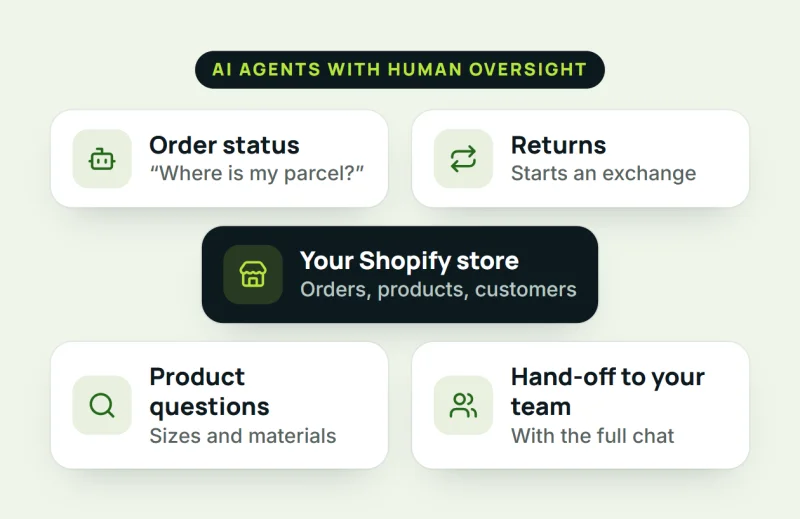
Illustration of AI agents handling order updates, returns and product questions, with hand-off to the store team

How AI shopping assistants choose products

Nobody outside the AI companies knows exactly how each assistant ranks products, and the methods will keep changing. The inputs they rely on, however, are fairly predictable:

  • Structured product data: titles, variants, prices, availability, barcodes and attributes held in a consistent format.
  • Descriptive detail: materials, fit, dimensions, use cases and care, written plainly enough to match a specific request.
  • Policies: delivery costs and times, returns windows and warranties that are easy to find and consistent across your site.
  • Reputation: reviews, ratings and what other websites say about your brand.

If a laptop bag listing never states which laptop sizes it fits, an assistant has little reason to recommend it, however good the photography. The same gap would also frustrate a human shopper, which is why this work pays off twice.

How to prepare your Shopify store for agentic commerce

Fix your product data first

Use Shopify metafields and metaobjects to store attributes such as material, dimensions and compatibility in a structured way, then display them on product pages. Fill gaps across the whole catalogue, not just best sellers, and keep variant names consistent. A Shopify partner can bulk-update attributes with tools such as Matrixify rather than editing products one at a time.

Connected icons branching out like a circuit, representing linked systems

Make policies easy to quote

Write delivery, returns and warranty information in short, plain sentences. If your footer promises 14-day returns and your FAQ page says 30, contradictions confuse assistants and customers alike.

Keep stock and prices accurate

Agents favour information they can trust. Out-of-date stock levels, or prices that differ between your store and your product feeds, lead to failed orders and erode confidence quickly.

Strengthen trust signals

Collect genuine reviews through a reputable reviews app, show clear contact details and make sure your About page explains who you are. Fake or misleading reviews are a consumer law issue in the UK, and the CMA has powers to act against businesses that use them, so never buy reviews or hide negative ones.

What to watch, and what to ignore

Expect a steady stream of announcements about AI shopping features, protocols and partnerships. Track the ones that affect your markets, test new channels when Shopify makes them available to your store, and measure referral traffic from AI assistants in your analytics. Be wary of anyone promising guaranteed placement inside an assistant: nobody can honestly sell that.

If you want an independent view of where agentic commerce fits in your wider plans, our AI Consulting for Shopify Brands service turns the noise into a prioritised, costed roadmap for your team.

Product-card tips for AI shopping assistants

  • Write titles that describe

    Lead product titles with what the item is, followed by its defining attributes, for example ‘Women's waterproof walking jacket, recycled shell, navy’. Brand flourishes can live in the description. Descriptive titles help assistants, search engines and shoppers scanning a collection understand the product at a glance, without guessing what a clever product name is supposed to mean.

  • Answer the obvious questions

    Add the details shoppers check before buying: dimensions in centimetres, weight, materials, care, what is in the box and who the product suits. If your customer service team answers the same question every week, that answer belongs on the product page, in plain words an AI assistant can quote accurately and a customer can trust.

  • Use identifiers and variants properly

    Add barcodes such as GTINs where your products have them, give each variant its own SKU, price and stock level, and avoid cramming several products into one listing. Clean variant structures make it far easier for any system, an AI agent included, to match the exact colour and size a shopper wants, first time.

  • Keep one version of the truth

    Make sure delivery times, prices, stock and returns rules match across product pages, policy pages, Google Merchant Center and marketing emails. Assistants may draw on several sources at once, and every contradiction chips away at trust. A monthly check of your top products across each channel catches drift before customers, or assistants, ever notice it.

Make sure AI search can find youAI Search Optimisation for Shopify

FAQs

Agentic commerce FAQs

Straight answers before you get in touch. More in our FAQs.

Is agentic commerce available in the UK yet?

Parts of it are. UK shoppers already use AI assistants to research and compare products, and some assistants show product results with prices and links. Features that let shoppers complete a purchase inside the conversation have tended to arrive in some markets before others, so check Shopify's help centre and each assistant's announcements for what is supported in the UK right now.

Do I need a special app to sell through AI assistants?

Not necessarily. Much of the groundwork is about data and content you already control in Shopify: product information, policies, stock and structured data. Where Shopify offers a direct connection to an AI channel, it will appear in your admin or sales channel settings. Be cautious about third-party tools that promise guaranteed placement inside any particular assistant, because no vendor controls those rankings.

Will agentic commerce replace my website?

Unlikely. Your store remains where orders are processed, where your brand story lives and where loyal customers return. What may change is how much research happens before a shopper arrives, and whether some purchases start elsewhere. That makes accurate product data and a smooth checkout more important, not less, and it still rewards a distinctive brand that shoppers search for by name.

How can I tell if AI assistants are sending traffic to my store?

Check referral sources in your analytics and in Shopify's reports for visits from AI assistant domains, and tag any links you control. Attribution is still imperfect, because some activity happens inside the assistant and never reaches your site. Look for trends over several months rather than reading too much into a single week of figures, and compare conversion with other channels.

Could an AI agent order the wrong item from my store?

An assistant can misread a request, especially when product data is vague. The shopper normally confirms the purchase, and your usual returns rules still apply. Clear sizing, compatibility notes and consistent variants reduce the chance of mismatches, and reviewing return reasons regularly shows whether AI-referred orders behave differently from your other orders, so you can fix the listings involved.

Does agentic commerce change my obligations under UK consumer law?

Your obligations stay the same however the customer found you. Descriptions must be accurate, prices clear, and statutory rights such as the 14-day cancellation period for most online purchases still apply. If an assistant relies on your product information, that information needs to be right, so treat accuracy checks as a compliance task as well as a marketing one.

Should small Shopify brands be preparing now?

Worry, no. Prepare, yes. The most useful steps, such as filling product data gaps, tidying policies and collecting genuine reviews, also lift conversion and search performance today. A small brand with clean, detailed listings can compete well, because a well-described product gives an assistant a clear reason to put it forward, whatever the size of the business behind it.

What does SAL charge for agentic commerce readiness work?

Most readiness projects sit within our AI for Shopify packages. Starter is from £995 ex VAT for Sidekick and Magic set-up plus AI search configuration, and Growth is from £2,495 ex VAT for an AI agent and automation. Larger catalogue or multi-market projects are quoted individually, always at a fixed price agreed before work begins and delivered under NDA.

Get your store ready for AI shoppers

We audit your Shopify catalogue, policies and feeds from an AI assistant's point of view, fix the data gaps holding your products back and set up the reporting that shows whether AI channels are sending shoppers your way, all at a fixed price, under NDA, with a dedicated project manager, specialist leads and weekly progress updates, so you always know what has changed and why.

Get a quote Call WhatsApp (opens in new tab)