
Smiling woman presenting charts on a whiteboard

AI & Ecommerce

AI Trends Shopify Merchants in the UK Should Act On in 2026

Eight AI trends shaping UK Shopify stores in 2026, from AI search and agents to product content and governance. See what to prioritise, then talk to SAL.

In this article (2 sections)
  1. Eight AI trends Shopify merchants should plan for
  2. How to prioritise these AI trends

Key takeaways

  • The AI trends Shopify merchants should care about in 2026 are the ones that change how shoppers discover products, how stores are run and how content gets made. Rather than chasing every announcement, judge each development by whether it affects your customers, your team's time or your margins in the next twelve months.
  • Discovery is shifting. AI-generated answers in search engines and conversational assistants mean shoppers may meet a summary of your product before they meet your website. Clear, factual, well-structured content and a recognisable brand are your best protection, and classic SEO still matters because AI answers draw on the same well-organised pages that rank today.
  • AI is becoming part of everyday store operations. Shopify Sidekick and Shopify Magic sit inside the admin, and AI agents are taking on support, stock alerts and reporting. The advantage goes to teams that build reliable habits, prompts and review steps around these tools rather than experimenting at random.
  • Product data is the common thread. AI search, shopping assistants, on-site search and automated ad campaigns all depend on complete, accurate product information. Fixing attributes, descriptions, identifiers and policies is the one piece of preparation that helps across almost every trend in this guide.
  • Governance moves from nice-to-have to necessary. As AI touches customer data and public-facing claims, UK brands need a simple policy covering approved tools, data use under UK GDPR and human sign-off, so adoption stays safe, consistent and easy to explain to customers, partners and anyone joining your team.

Every week brings another AI announcement, and it is hard to tell which ones matter to a UK Shopify brand with real targets and a small team. This guide cuts through the noise. We look at the shifts in AI ecommerce that are already changing how shoppers find products, how stores are run and how content is produced, and we separate what deserves action this year from what is simply worth watching. No hype and no invented forecasts: just the AI trends Shopify merchants can plan around with confidence.

1. AI search is reshaping discovery

Google's AI Overviews and conversational tools such as ChatGPT and Perplexity now answer many product questions directly, so shoppers may read a summary before they see your listing. Stores with clear, factual content, structured data and a recognisable brand are better placed to be cited. Keep investing in classic SEO, because AI answers still draw on well-organised websites.

2. Shopping assistants move towards checkout

Agentic commerce, where an assistant shortlists products and sometimes helps a shopper buy, is emerging in some markets, where supported. It is early days, and features vary by assistant and country, but the preparation it needs, complete product data and consistent policies, also lifts conversion on your own site today.

3. AI in the admin becomes routine

Sidekick and Magic are turning AI into an everyday part of running a store: answering questions about sales, preparing discounts and writing first-draft copy. The trend for 2026 is less about new features and more about teams building dependable habits, shared prompts and review steps around them.
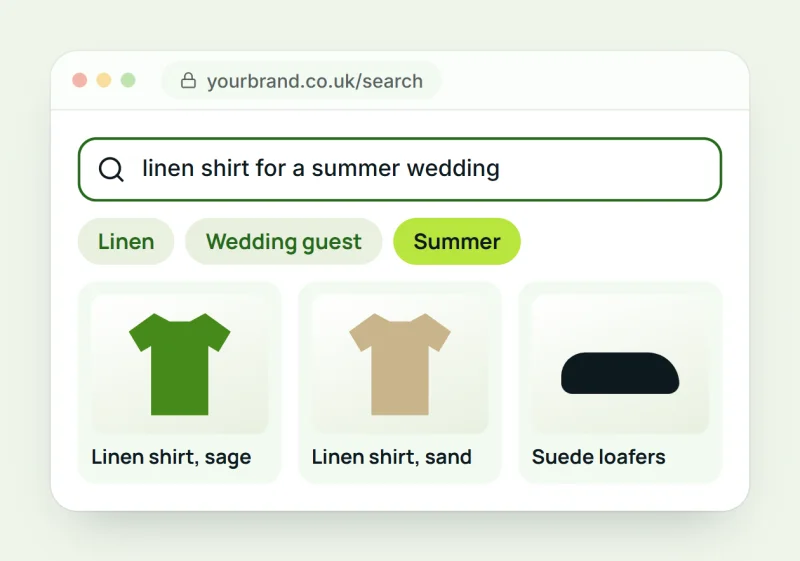
Illustration of natural-language search on a Shopify store matching a shopper’s question to products

4. Agents take on back-office work

AI agents connected to helpdesks, Shopify Flow and inventory tools are handling order-status queries, ticket triage and stock alerts. The stores that benefit most give agents narrow jobs, tight permissions and human approval for anything costly or customer-facing.

5. Content at scale meets a higher quality bar

Generating product descriptions, alt text and translations is now quick and cheap, so quality is the differentiator: unique detail, accurate claims and British English. Google's guidance focuses on whether content helps people rather than how it was made, and mass-produced pages with little value carry real risk. A Brighton skincare brand, for example, is better served by fifty carefully edited descriptions than by five hundred generic ones.

6. Smarter on-site search and merchandising

Shoppers increasingly type natural phrases such as ‘linen shirt for a summer wedding’ into store search. AI-assisted search and recommendation apps help interpret intent, handle typos and surface relevant products, which matters most for large catalogues and for mobile shoppers who will not scroll through pages of near misses.

7. Ad platforms lean harder on automation

Google's Performance Max and Meta's Advantage+ campaigns use machine learning to decide where ads appear and who sees them. Your influence shifts to the inputs: clean product feeds, strong creative, accurate conversion tracking and first-party data collected with proper consent.

Hand drawing a glowing upward line labelled performance

8. Governance moves up the agenda

As AI touches customer data and public-facing content, UK brands need simple rules on approved tools, data use and sign-off. UK GDPR still applies, the ICO has published guidance on AI and data protection, and advertising rules cover AI-written claims just as they cover human ones.

Act nowPlan this yearWatch closely
Product data and content qualityA first AI agent for supportCheckout inside AI assistants
Sidekick and Magic habitsAI-assisted site searchNew AI shopping protocols
AI governance basicsFeed and tracking clean-upVoice and visual shopping

Start with the left-hand column, because those steps support everything else and pay back even if the trends further right develop slowly. Plan the middle column into your budget for the year, and review the right-hand column each quarter rather than acting on headlines. For a tailored view of which trends matter most to your store, our AI Consulting for Shopify Brands workshop maps opportunities, costs and risks into a practical roadmap your team can act on.

Quick tips for staying ahead of AI trends

  • Audit your product data

    AI search, shopping assistants and ad platforms all rely on product information. Export your catalogue and look for missing attributes, inconsistent sizing, thin descriptions and absent barcodes. Fixing those gaps is one piece of preparation that helps across almost every channel, whichever trend grows fastest for your brand over the coming year. Start with your top sellers.

  • Track AI referrals

    Build a simple report showing visits and orders referred by AI assistants such as ChatGPT, Perplexity, Gemini and Copilot. The numbers may be small today, but a monthly view tells you whether the channel is growing for your brand, which products it favours and whether those shoppers convert better or worse than other visitors.

  • Agree an AI use policy

    Write a one-page policy covering approved tools, what customer data may be entered, who signs off AI-written content and how mistakes are reported. It keeps experimentation safe, makes onboarding new starters easier and gives you a clear, confident answer when a partner, supplier or customer asks how your business uses AI.

  • Run one experiment a quarter

    Rather than chasing every launch, pick one trend each quarter, set a clear goal and measure it against a baseline. Three months is long enough to see results and short enough to stop cleanly if it does not work. Share what you learn across the team so the knowledge builds steadily over the year rather than living in one person's head.

Explore AI for your Shopify storeAI for Shopify Stores

FAQs

AI trends for Shopify: FAQs

Straight answers before you get in touch. More in our FAQs.

Which AI trend should a small Shopify store focus on first?

Start with product data and content quality. Clear titles, complete attributes, accurate descriptions and consistent policies help shoppers on your own site, strengthen classic search and prepare you for AI search and shopping assistants. It needs no new software, only time and a plan, and every other AI trend works better when this foundation is solid and kept up to date.

Is AI search going to replace Google SEO?

Not in the short term. Google remains a major source of discovery for UK shoppers, and its own AI features draw on web content. What is changing is how results are presented and how often people click through. Strong technical SEO, helpful content and structured data remain the foundation for both traditional and AI-driven search, so keep investing in both together.

Do I need to use AI to keep up with competitors?

You do not need every tool, but ignoring AI altogether means missing time savings that competitors are already using, especially in content, reporting and customer service. Pick a few tasks where AI clearly helps, measure the effect and build from there. Thoughtful adoption beats both rushing in with everything and standing still while others learn.

How will AI change advertising for Shopify brands?

Platforms such as Google and Meta now automate much of the targeting and bidding in their campaigns. The advantage moves to the inputs you control: accurate product feeds, distinctive creative, reliable conversion tracking and consented first-party data. Brands that keep those foundations clean give the algorithms better material and spend less time fighting the automation or second-guessing every result.

What are the main risks of using AI in ecommerce?

The main risks are inaccurate content, misleading claims, data protection breaches and over-reliance on tools nobody checks. Each is manageable with simple controls: human review for customer-facing content, limited data access, vendor checks and a clear written policy. Problems usually start when AI is adopted informally, one staff member and one tool at a time, with nobody keeping track.

Will AI shopping assistants send traffic to UK Shopify stores?

Some already do, through links in AI answers and product suggestions. The volume varies widely by sector and is hard to measure precisely, because part of the journey happens inside the assistant. Track referrals in your analytics, keep product data complete and treat it as an emerging channel rather than a replacement for search, email or social media for now.

How often should we review our AI plans?

Quarterly works well for most brands. AI products change quickly, so a quarterly check lets you see what your tools can now do, retire experiments that did not work and add the next priority. Pair it with a monthly look at the measures you chose at the start, such as time saved, response times or conversion, so decisions rest on evidence.

How can SAL help us act on these AI trends?

Most brands begin with AI Consulting, from £495 ex VAT for a workshop and AI opportunity report, or from £1,495 for a roadmap and prototype. When you are ready to implement, our AI for Shopify packages start from £995 ex VAT for Sidekick, Magic and AI search set-up, with larger projects quoted at a fixed price and delivered under NDA.

Get a quote Call WhatsApp (opens in new tab)