
Few jobs eat into a growing Shopify brand's week like writing product copy. A new season might bring two hundred products, each needing a description that is accurate, persuasive and different from every other retailer selling something similar. AI product descriptions promise to clear that backlog in an afternoon, yet many merchants worry that AI-written copy will damage their search rankings. Used carelessly, it can. Used well, it can strengthen them. This guide sets out a workflow UK brands can use to get the speed of AI without the SEO downside.
Does Google penalise AI product descriptions?
Google's published position is that it rewards helpful, original content however it is produced. What its spam policies target is content generated at scale mainly to manipulate rankings, with little value for readers. For an online shop, the danger is not the tool but the result: hundreds of interchangeable descriptions that tell a shopper nothing they could not guess from the product title.
Where AI-written product copy goes wrong
- Generic filler: phrases like ‘elevate your style’ that add words but no information.
- Invented details: materials, features or dimensions the AI simply guessed.
- Duplication: near-identical copy across variants and similar products.
- Lost keywords: rewrites that remove the terms a page already ranked for.
- American English: ‘color’, ‘pants’ and ‘sweater’ confusing UK shoppers.
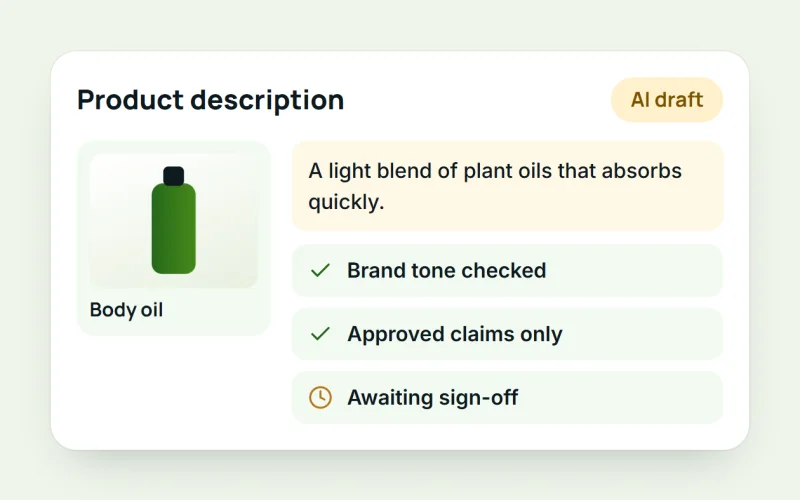
A safe workflow for AI product descriptions
1. Protect what already ranks
Export performance data from Google Search Console and flag product pages that already earn impressions and clicks. Leave those until last, and change them in small, measured batches.
2. Build a structured brief
Feed the AI real attributes from your product data or metafields: materials, dimensions, fit, care, origin and what is in the box. Add your house style, the target keyword and two or three questions customers often ask. Shopify Magic can draft from inputs like these directly inside the product editor.
3. Draft, then edit like an expert
Treat the output as a first draft. An editor who knows the range checks every fact, adds the detail only your team knows, such as how a fabric feels or whether a size runs small, and cuts anything generic.
4. Check the SEO basics
Confirm that the product title, the opening of the description, image alt text and the meta description use the main keyword naturally. Keep URLs unchanged, and make each similar product genuinely distinct rather than a reworded twin.
5. Publish in batches and measure
Roll changes out one collection at a time and compare impressions, clicks and conversion against the previous period. If a batch underperforms, you will spot it quickly and can adjust before touching the rest of the catalogue.

What a strong AI-assisted description looks like
Picture a Yorkshire knitwear brand launching a new jumper. A weak AI draft says it is ‘cosy, stylish and perfect for any occasion’. A strong one, built from a proper brief and edited by someone who knows the range, explains the yarn and where it is spun, how the fit compares with last season, whether it suits layering, how to wash it and what customers say about sizing. The second version answers real questions, uses the words shoppers search for and could only belong to that brand.
Handling variants and near-duplicates
Colourways of the same product rarely need separate descriptions. Keep them as variants of one product so there is a single, stronger page. Where products are genuinely different, such as two sofas from the same range, make sure each description explains what sets it apart.
Stay compliant with UK rules
The CAP Code, administered by the ASA, covers marketing claims on your own website, and the CMA's Green Claims Code applies to environmental wording. AI tools sound confident even when they are wrong, so claims such as ‘sustainable’, ‘hypoallergenic’ or ‘clinically proven’ need evidence and a human sign-off before publishing.
If you are planning AI content across a large catalogue, our AI Consulting for Shopify Brands service can design the prompts, review process and measurement plan before you scale up.