
Your agency has just won a Shopify brief, but the team is already stretched. Or you run a design studio in Shoreditch or a growth agency in Leeds with brilliant designers and strategists, yet nobody who writes Liquid, Shopify's theme language. Turning the work away hands the client to a competitor. That is where white label shopify development comes in: a specialist partner builds under your brand while you keep the relationship, the margin and the credit. Here is how white label Shopify partnerships work and what UK agencies should check before signing one.
Who uses white label Shopify development?
- Design and branding studios that create the look but need developers to turn it into a working Shopify theme.
- Marketing, PPC and SEO agencies whose clients need a new store, a migration or high-converting landing pages.
- Shopify agencies that need overflow capacity for peak season or a large Shopify Plus project.
- Independent consultants who manage clients directly but prefer not to code.
The common thread is simple: demand for Shopify work that your agency wants to keep, without the cost and risk of building a development team from scratch.
Common white label engagement models
Fixed-price projects
Best for defined builds such as a new store, a redesign or a migration from WooCommerce or Magento. You receive a scoped quote, add your margin and present one figure to your client.
Retained hours
A monthly bank of hours covers fixes, updates and small features across your client portfolio, so you can sell ongoing support without staffing it yourself. It also gives your account managers a reliable answer when a client asks who looks after the store after launch.
Dedicated developer
When work is steady, a part-time or full-time developer slots into your team, joins your stand-ups and follows your processes and tools. It is the closest thing to an in-house hire, without the recruitment cost or the management overhead.
How a white label project runs
- NDA and non-solicit signed before any client information is shared.
- Brief review: designs, sitemap and integrations checked, with gaps flagged before quoting.
- Fixed quote and timeline agreed in writing.
- Secure access to the client's store through least-privilege staff accounts with 2FA.
- Sprints and QA, with 4-eyes review before anything reaches you.
- Unbranded handover: staging links, documentation and training material under your name.

Protecting your client relationships
The biggest worry for any agency is a partner going direct. A non-solicit clause should cover your clients and your staff for an agreed period, and unbranded deliverables mean nothing in the store, the code or the reports points back to the partner. Data handling matters just as much: client data should be processed under UK GDPR, never used to train AI models, and returned or deleted at contract end. Our page on data security, NDA and confidentiality sets out exactly how we handle each of these points. Ask any partner to show you its non-solicit wording before the first project, not after.
Questions to ask a white label Shopify partner
- Who will actually do the work, and how are they managed?
- How is code reviewed and tested before we see it?
- Where does the code live, and who owns it on payment?
- How are scope changes priced and approved?
- What support is available after launch, and in whose name?
- How do you handle peak periods such as Black Friday, when every agency is busy at once?
Ask how they use AI in delivery too, because your clients will. Our guide to AI for Shopify Stores covers where it adds real value to client stores, from product content to customer service.
How we work with agencies
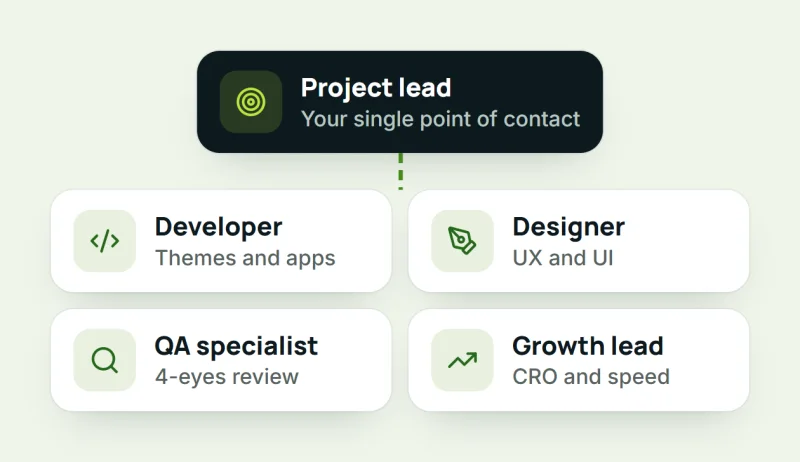
At Shopify Agency London, white label projects run on the same ten-step process as our own: NDA and discovery, a fixed quote, sprint delivery led by a dedicated project manager, QA with 4-eyes review, recorded walkthroughs for your sign-off and SLA support after launch, all reported to you and never to your client. Your account managers stay the face of the project, while our specialist leads handle the technical detail behind them.